
Giving to Clemson

FAQs

 1.      What is the Clemson University Foundation?

The Clemson University Foundation is an independent, non-profit organization incorporated in South Carolina. Chartered in 1933, its purpose is to promote the welfare and future development of Clemson University through supporting its scientific and educational goals.

 2.      What is the Foundation’s tax status?

The Clemson University Foundation is a registered 501(c) (3) charitable organization.

 3.      Is my gift tax deductible?

Your gift qualifies for tax deduction in accordance with IRS regulations during the calendar year that you make your gift. You will receive a gift acknowledgement for your files. Consult your tax professional for more information.

 4.      Who governs the Foundation?

The Foundation is governed by a 43 member volunteer Board of Directors. The Board consists of both elected and automatic directors. Elected directors serve 4-year terms.

 5.      What is an endowment?

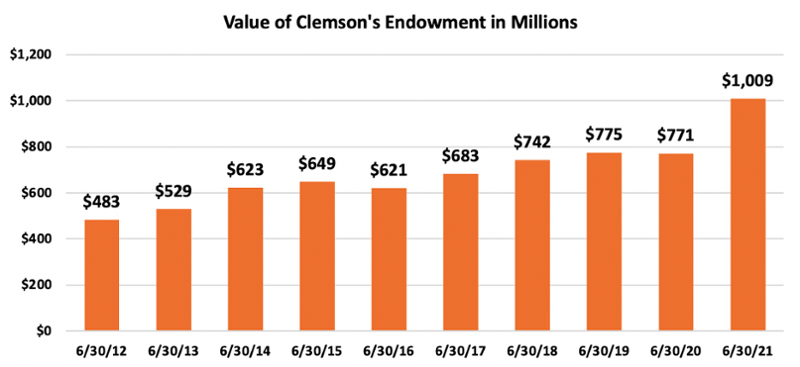
An endowment is meant to provide a perpetual source of income for scholarships, faculty and University programs for generations of Clemson students. When an endowment is established, your gift, the principal (or corpus), is invested long-term and a portion of the annual earnings are paid out to support the designated purpose for which the endowment was established. The goal is to ensure that the principal maintains its purchasing power over time to support future generations.

 6.      Why are endowments important to Clemson University? 

As other sources of revenues such as state appropriations, grants and research sponsorship can be unpredictable, an endowment provides a consistent, reliable, perpetual source of income for programs and services that inspire and fund above-average achievement by students and faculty. The larger the endowment is, the greater the income that can be provided; therefore the more opportunities available for students, faculty and strategic University programs.

 7.      What legal requirements regulate endowments in South Carolina?

In 2008, South Carolina enacted the Uniform Prudent Management of Institutional Funds Act (UPMIFA).  (See Legislative History of South Carolina Management of Institutional Funds law: 1972 UMIFA, SC ST §34-6-10 through §34-6-80).  UPMIFA is designed to replace the existing Uniform Management of Institutional Funds Act (UMIFA), which was approved by the National Conference of Commissioners on Uniform State Laws in 1972.  This act provided uniform and fundamental rules for the investment of funds held by charitable institutions and the expenditure of funds donated as “endowments” to those institutions.  Those rules supported two general principles: 1) that assets would be invested prudently in diversified investments that sought growth as well as income, and 2) that appreciation of those assets could prudently be spent for the purposes of any endowment fund held by a charitable institution.  UPMIFA, as an update and successor to UMIFA, establishes an even sounder and more unified basis for charitable fund management than UMIFA.

 8.      Who is responsible for managing Foundation investments?

The Investment Committee of the Clemson University Foundation provides direction and recommendations to the Board of Directors for the investment of the financial assets of the Foundation, and those other assets for which the Foundation has fiduciary responsibility. The primary purpose of the Investment Committee is to manage the investment and disbursement of assets of the Foundation and those managed by the Foundation, while maintaining prudent fiduciary standards.

 9.      How are endowment assets invested?

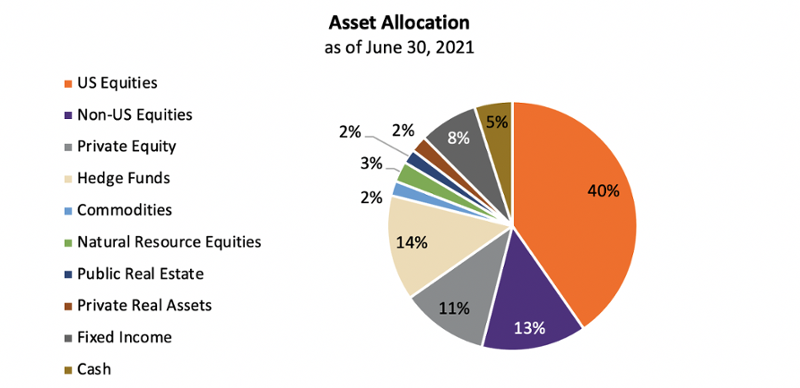
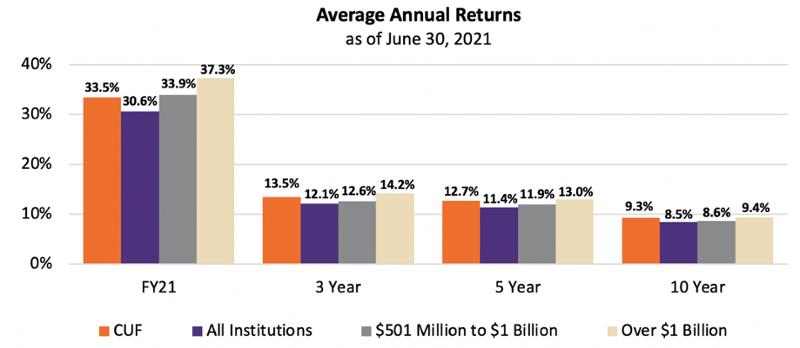
Each of the endowments managed by CUF essentially operates as an independent account.  The assets of the individual funds or accounts are pooled and invested as a single portfolio.  In addition to reducing administrative expense, this provides additional investment opportunities for these funds due to economies of scale associated with many of the asset classes.  CUF invests the managed endowment so as to maximize long-term returns, while simultaneously mitigating risk through maintaining a diversified portfolio.

 10.  What is asset allocation?

Asset allocation involves dividing your assets on a percentage basis among different broad categories of investments. The selection of investment classes has been shown to be one of the most important determinants of the portfolio return.   In fact, research in portfolio management has shown that the allocation among assets explains up to 90% of the volatility of portfolio returns, whereas stock selection explains less than 10%. Clemson University Foundation’s Board of Directors approve the Investment Policy of the Foundation, which includes asset allocation guidelines.

 11.  How is endowment spending determined?

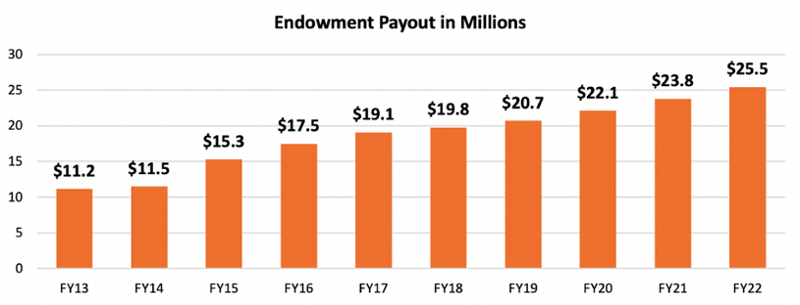
The Board of Directors approves an endowment spending policy, recommended by the Investment Committee. The Clemson University Foundation spending policy is based on a total return approach in order to maintain stable cash flows over an extended period of time, to protect endowment funds against inflation and to preserve and grow the purchasing power of the endowment. For Fiscal Year 2009 the spending policy of the Foundation is to spend 4.00% of the endowment’s average market value for years ending 6/30/07, 6/30/06, and 6/30/05 for the purpose specified by the endowment’s fund agreement.

 12.  Are there fees on endowments?

An administrative/management fee is annually charged to endowments.  The fee is assessed quarterly based on the beginning market value of all endowments for the period.  The fee for FY 2010 is 1.25%.