About
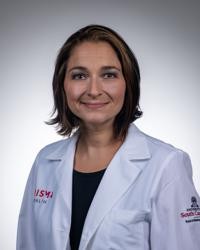
Dr. Sarah Fabiano is an emergency medicine physician with subspecialty certification in EMS. She has led and participated in numerous research initiatives spanning prehospital medicine, quality improvement, and medical engineering collaboration, including projects with Clemson graduate medical engineering programs and graduate-level QI initiatives.
Her scholarly work includes multiple publications, presentations, and podcasts covering diverse topics such as complex case reviews, progressive EMS practices, stadium medicine supporting Clemson Football and large-scale special events, and medication safety topics including acetaminophen use in pregnancy.
Dr. Fabiano’s current research focuses on advancing Finger-to-Nose testing as a practical prehospital screening tool for posterior circulation stroke. She is also investing the impact of various bag-valve-mask sizes compared to mechanical ventilation on out-of-hospital cardiac arrest outcomes and return of spontaneous circulation rates. Additionally, she serves as a collaborator on a grant-funded community paramedicine program in Greenville County that integrates as nurse practitioner and community paramedic to treat low-acuity patients in the field, improving access to care while reducing unnecessary emergency department utilization.
Her work centers on advancing evidence-based prehospital care, expanding EMS capabilities, and building systems that improve patient outcomes.
How their research is transforming health care
My research is focused on advancing prehospital medicine as a critical driver of community health improvement. I am focused on identifying practical, evidence-based strategies that allow EMS systems to deliver higher-quality, earlier interventions that meaningfully affect outcomes.
Current areas of investigation include improving stroke recognition through enhanced prehospital screening tools, optimizing ventilation strategies during out-of-hospital cardiac arrest to improve survival and neurologic outcomes, and expanding community paramedicine models to better address low-acuity and high-risk patients outside of traditional emergency department settings. Through these initiatives, I would like to strengthen early decision-making in the field while ensuring that care is both clinically sound and operationally feasible.
The theme of my work is addressing healthcare disparities. By leveraging EMS as a point of early access, community paramedicine programs and field-based interventions can help close gaps in care for vulnerable populations, reduce unnecessary emergency department utilization, and improve continuity of care.
My goal is to translate research into scalable system-level changes, improve survival, enhance equity, and build a stronger, more responsive model of care for the communities we serve.
Health research keywords
Prehospital Medicine, Emergency Medical Services, Community Paramedicine, Posterior Circulation Stroke, Community Health, Airway Management, Stroke Screening, Healthcare Innovation, Access to Care
