Skip to content

Supreme Court of South Carolina at Clemson University

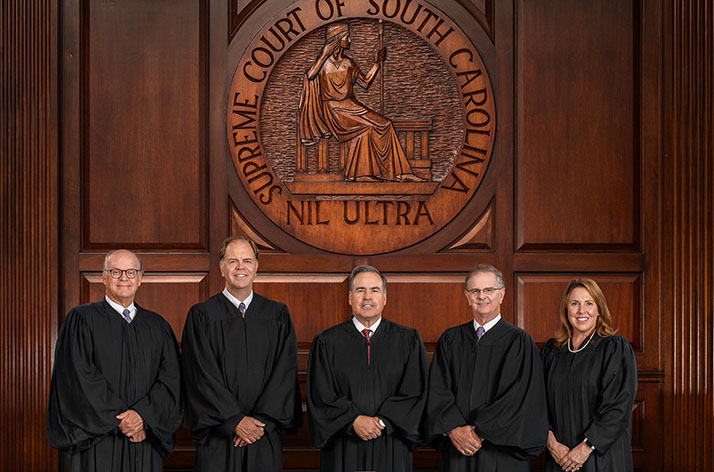
The five South Carolina Supreme Court Justices sitting behind the bench.

Dates

September 15-16, 2026

Location

Clemson University
Brooks Center for the Performing Arts
141 Jersey Lane
Clemson, SC 29634

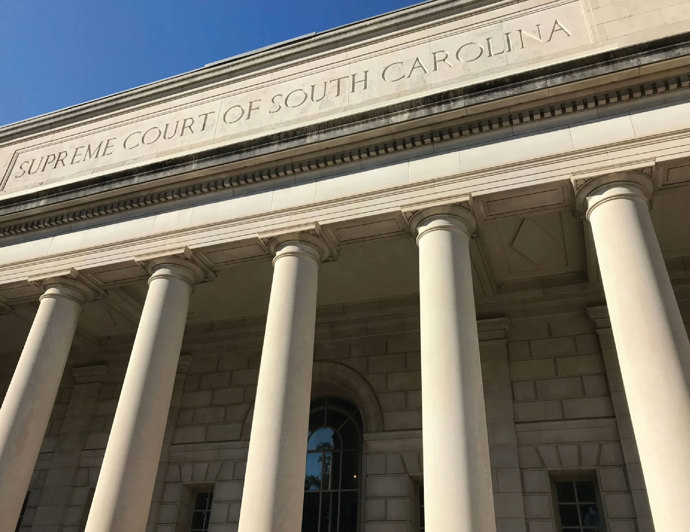
The Supreme Court of South Carolina, as part of a unique program designed to promote accessibility and engagement with communities throughout the state, scheduled its September 15-16, 2026, session at Clemson University’s Brooks Center for the Performing Arts.

Over the course of two days, cases will be scheduled for the five justices to hear. Two sessions will be held each day at the Brooks Center on Clemson’s main campus. Sessions are free and open to the public to attend.

  About the South Carolina Supreme Court

The Supreme Court of South Carolina is the highest court in the state. It sits at the top of a unified court system that includes the Supreme Court, a court of appeals, a circuit court and other courts mandated by law.

The South Carolina Supreme Court justices stand in front of their bench.

Free Legal Clinic

In conjunction with the South Carolina Supreme Court’s visit to Clemson, the South Carolina Bar’s Pro Bono Program will host a free legal clinic on Tuesday, September 15, from 11 a.m. to 3 p.m. at the Littlejohn Community Center.

Attendees can receive guidance on:

  • Wills and health care powers of attorney
  • Expungements and pardons
  • General civil legal questions

The clinic is presented in partnership with South Carolina Legal Services, Time Served and the USC School of Law.

Dates

September 15-16, 2026

Location

Clemson University
Brooks Center for the Performing Arts
141 Jersey Lane
Clemson, SC 29634

 See the Cases: In Brief

  • Tuesday, September 15, 2026

    10 a.m. (time limits: 15-15-5)

    Case No. 2026-000032: South Carolina Public Interest Foundation and James Weninger, Plaintiffs, v. Henry McMaster, in his official capacity as Governor of the State of South Carolina and Major General Robin B. Stilwell, in his official capacity as Adjutant General of the South Carolina National Guard, Defendants.

    Summary: Plaintiffs contend that Governor McMaster's deployment of South Carolina National Guard members to Washington, D.C., exceeded the Governor's legal authority.
    David Allen Chaney, Jr., of SCLU of South Carolina, of Columbia; James G. Carpenter, of The Carpenter Law Firm, of Greenville; and Aman T. George, William B. Bardwell and Brian D. Netter, all of Washington, D.C., for Plaintiffs. Agency General Counsel William David Kelly, III, of the Office of Adjutant General, of Columbia, for Defendant Adjutant Major General Robin B. Stilwell. Chief Legal Counsel William Grayson Lambert, Deputy Legal Counsel Erica Wells Shedd, Deputy Legal Counsel Tyra S. McBride, and Deputy Legal Counsel Cameron Reagan Cox, of the Office of the Governor, of Columbia, for Defendant Governor Henry Dargan McMaster. Vordman Carlisle Traywick, III and Sarah Cameron Frierson, of Robinson Gray Stepp & Laffitte, LLC, of Columbia, for Amicus Curiae Thomas C. Alexander, in his official capacity as President of the Senate, and Amicus Curiae George Murrell Smith, Jr., in his official capacity as Speaker of the House of Representatives. Michael Gary Corley and Jessie Allison White, both of South Carolina Environmental Law Project, for Amici Curiae South Carolina Coastal Conservation League, Sierra Club, The League of Women Voters of South Carolina, Friends of Coastal South Carolina, Charleston Waterkeeper, Savannah Riverkeeper, Winya Rivers Alliance, Gullah/Geechee Sea Island Coalition, Congaree Riverkeeper, Coastal Expeditions, and Carolina Ocean Alliance.


    11:30 a.m. (time limits: 15-15-5)

    Case No. 2023-000831: Thomas Ravenel, Appellant, v. Kathryn Dennis, Respondent.

    Summary: In this appeal, the Court will consider whether the trial court erred in denying the Petitioner's motion to unseal the record in this family court proceeding.
    Kelley D. Andrews-Edwards, of The Andrews Law Firm, LLC and Arielle Na'Rae Larsen, of Larsen Law, LLC, both of Mt. Pleasant; and Aaron Eric Edwards, of George Sink, PA, of North Charleston, all for Appellant. Thomas Christian Davis, of Harvey & Battey, PA, of Beaufort, for Respondent. Elizabeth J. Stringer, of Elizabeth J. Stringer, LLC, of Charleston, as Guardian Ad Litem
  • Wednesday, September 16, 2026

    10 a.m. (no time limits noted)

    Case No. 2025-001691: Marcus Wright, Petitioner, v. State of South Carolina, Respondent.

    Falkner Wilkes, of Oakland, MS, for Petitioner. Attorney General Alan McCrory Wilson and Senior Assistant Deputy Attorney General Mark Reynolds Farthing, of Columbia, for Respondent.


    11:30 a.m. (time limits: 15-15-5)

    Case No. 2025-002086: Reid Fleming, Petitioner, v. The Planet Vape, LLC; SCECIGARETTE, LLC; LG Chem, Ltd.; John Doe Distributor #1; John Doe Distributor #2; and John Doe Distributor #3; Defendants, of which LG Chem, Ltd. is the Respondent.

    Summary:The Court will consider whether the court of appeals erred in affirming the circuit court's order concluding it lacked specific personal jurisdiction over Respondent LG Chem, Ltd.
    Chris Moore, of Florence and Grace Madeline Sturman, of Columbia, both of Richardson Thomas, LLC; John Preston Griffith, of Smith & Griffith, LLP, of Anderson, all for Petitioner. C. Mitchell Brown, Rachel Atkin Hedley and Allen Mattison Bogan, of Nelson Mullins Riley & Scarborough, LLP, of Columbia, for Respondent.

 Watch Court Videos

Supreme Court Video Portal

Frequently Asked Questions

  • What does it mean to say the Supreme Court has appellate jurisdiction?

    Primarily, the Supreme Court is an appellate court, which means that it reviews rulings of law reached by lower courts at trial or on appeal from other tribunals and agencies. In deciding appeals, the Supreme Court considers the transcript of the proceedings before the lower court, other relevant documents and exhibits, briefs filed by the parties and oral arguments. For those appeals that are decided by the Court of Appeals, an aggrieved party may seek a review of the decision of the Court of Appeals by filing a petition for a writ of certiorari with the Supreme Court. If the petition is granted, the Supreme Court may affirm, reverse or modify the decision of the Court of Appeals.

  • Why is the Court hearing oral arguments at Clemson University?

    The South Carolina Supreme Court is in session at Clemson University as part of a unique program designed to promote accessibility and engagement with communities throughout the state. Many members of the public do not have the chance to see and understand what goes on in real-life courtrooms, much less at the level of the state's supreme court. This is a rare and special opportunity for the Clemson community to observe the judicial process at the highest level in the state. Clemson University was chosen, in part, thanks to the strong ties of Clemson’s first-ever Jurist in Residence, Clemson alumnus and former circuit court Judge Gary Clary, to the judicial community.

  • How does the Court prepare to hear oral arguments and write opinions?

    Members of the Supreme Court prepare to hear arguments by studying the case record and briefs of the parties. One member of the Court will be assigned to prepare an opinion, which is then considered in turn by the remaining justices. If a majority concurs in the opinion, it will then be filed and published. Justices who disagree with the majority often write dissenting opinions, which are also published along with the holding of the Court.

  • What are the time limits for oral arguments?

    The petitioner's attorney speaks first, followed by the respondent's attorney. Each is allowed 15 minutes, and the petitioner is then allowed an additional five minutes to reply to the respondent.

  • When will the Supreme Court hand down its ruling?

    There is no set date for when the Court needs to rule on a case. Sometimes, it can happen as soon as the next day. Other times, it might be delayed for a year or more. Typically, the Court issues an opinion within three to four months.

Terms to Know

  • Discovery
    The formal process of exchanging information between the parties about the witnesses and evidence they'll present at trial.
  • Reversible error

    A procedural error during a trial or hearing sufficiently harmful to justify reversing the judgment of the lower court.

  • Respondent

    The person against whom the appeal is made.

  • Writ of certiorari

    An order issued by the Supreme Court, in cases where it has the discretion whether or not to hear an appeal, electing to entertain the matter and review the decision of the lower court.

  • Plaintiff

    The party who brings a civil suit in a court of law.

  • Petitioner

    A party who presents a petition to a court or other official body, especially when seeking relief on appeal. Because most appeals come from the court of appeals, the party who lost at the court of appeals is the petitioner, whereas the party that won is the respondent.

  • Appellants

    A party who appeals a lower court’s decision. In essence, the appellant, like the petitioner, lost below, whereas the appellee, like the respondent, won below.

  • Defendant

    A person sued in a civil proceeding or accused in a criminal proceeding.

  • Judicial Review

    A court’s power to review the actions of other branches or levels of government, or the ability to review a lower court’s factual and legal findings.

  • Certified Question

    When an issue before a federal court involves a question of state law that is not clearly defined by previous opinions from the state court of appeals or state supreme court, then the federal court may ask the state supreme court to answer the legal question.

  Meet the Justices

  • Chief Justice John W. Kittredge

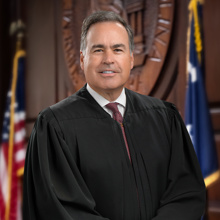
    Justice Kittredge headshotJohn W. Kittredge was born in Greenville, South Carolina. John is the son of Elwyn Herbert Jr. (deceased) and Marian Jeffries Kittredge (deceased). John married Lila Graham Hewell on June 20, 1981. John and Lila have three children, Lila Marian, Will and Zay. They have six grandchildren, Jeff, Elwyn, Marian, Lila, Murray and Evelyn.
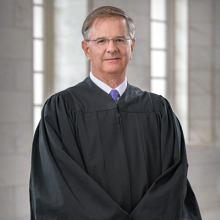
    Chief Justice Kittredge graduated from the University of South Carolina, summa cum laude, in 1979. He graduated from the University of South Carolina School of Law in 1982. Academic honors include Phi Beta Kappa, Order of the Coif and Wig and Robe.

    Chief Justice Kittredge began his legal career as a law clerk to The Honorable William W. Wilkins Jr. He practiced law in the firm of Wilkins, Nelson and Kittredge. Chief Justice Kittredge was actively involved in community and state service: Governor's Committee on Crime and Delinquency; Governor's Juvenile Justice Task Force; Greenville Technical College Foundation (vice president); City of Greenville Civil Service Commission (chairman); Greenville County Crime Stoppers (president); and Board of Directors of Child Evangelism Fellowship. Chief Justice Kittredge has served on the Commission on the Profession since 2003, serving as chair from 2008 until 2024. In addition to his admission to the South Carolina Bar, Chief Justice Kittredge is also admitted to practice before the District of Columbia Court of Appeals, United States Court of Military Appeals, United States District Court for the District of South Carolina, United States Fourth Circuit Court of Appeals and the United States Supreme Court.

    Chief Justice Kittredge was elected to the South Carolina family court bench in 1991. He was elected to the circuit court bench in 1996 and the Court of Appeals in 2003. He was elected as an associate justice to the Supreme Court in 2008 and Chief Justice in 2024.

  • Justice George C. James Jr.

    Justice James headshotJustice James was born in 1960 in Savannah, Georgia, and grew up in Sumter. He is the son of the late Ren F. James and the late George C. James. He is married to the former Dena Owen. They have two children and two grandchildren.
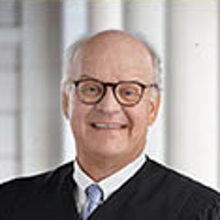
    Justice James graduated from Wilson Hall School in Sumter and graduated from The Citadel in 1982, earning a B.S. in business administration. He earned his juris doctor degree from the University of South Carolina School of Law in 1985.

    In 1985, Justice James joined the firm of Richardson, James & Player. He practiced with his father, the late George C. James, and with the late Henry B. Richardson Jr., Thomas E. Player Jr., and his brother, John E. James III. In 2000, the firm merged with Lee, Erter, Wilson, Holler & Smith and became known as Lee, Erter, Wilson, James, Holler & Smith LLC. Justice James was a partner in that firm until his election to the circuit court bench in 2006.

    Justice James was sworn in as a resident circuit judge for the Third Judicial Circuit on July 1, 2006, replacing the retiring Howard P. King. He served as a Business Court judge and was the 2009 recipient of the Matthew J. Perry Civility Award from the Richland County Bar Association. Justice James was elected to the Supreme Court on February 1, 2017, and was sworn in on February 7, 2017. He was re-elected in 2020 to a 10-year term.

    In addition to being a member of the South Carolina Bar Association and the Sumter County Bar Association, Judge James is a member of the Judicial Division of the American Bar Association. He is the treasurer of the Appellate Judges Conference of the ABA and is the finance officer of the Appellate Judges Education Institute. He is a former member of the South Carolina Defense Trial Attorneys Association and the Defense Research Institute.

  • Justice D. Garrison Hill

    Justice Hill headshotD. Garrison "Gary" Hill was born in Greenville, South Carolina, in 1964. His late father, Leo H. Hill, was former president of the South Carolina Bar; his late mother, Dr. Grace L. Hill, was a teacher and school psychologist. He has a sister, Lillian H. Pinto, and a brother, L. Howard Hill Jr.
    Justice Hill received a B.A. degree magna cum laude from Wofford College in 1986 and his juris doctor from USC Law School in 1989, where he was a member of the South Carolina Law Review.

    After graduating from law school, he served as law clerk to Judge Billy Wilkins of the U.S. Court of Appeals for the Fourth Circuit. From 1990 to 2000, he was a member of Hill, Wyatt & Bannister, a general civil and criminal practice law firm in Greenville. In 2000, he and his father started Hill & Hill LLC, which was listed in the Martindale-Hubbell Bar Register of Pre-Eminent Lawyers. The firm primarily handled business litigation, government law and public utility law, including the representation of numerous special-purpose districts throughout the state.

    From 2004 to 2017, he served as a resident Circuit Judge for the Thirteenth Circuit. On February 1, 2017, he was elected to the Court of Appeals. On February 8, 2023, he was elected an associate justice of the Supreme Court.

    Justice Hill served in the House of Delegates of the South Carolina Bar and as president of the Government Law Section. He is also the former editor-in-chief of the South Carolina Lawyer and the author of several legal articles. He and his father published Doing the Public's Business, a legal guide designed to assist lay members who serve on the boards of public bodies.

    While in private practice, he served on the boards of the Greenville Literacy Association, Greenville Mental Health Association, YMCA Camp Greenville and as chairman of the City of Greenville Board of Zoning Appeals.

    He has three children and is a member of Westminster Presbyterian Church.

  • Justice Letitia H. Verdin

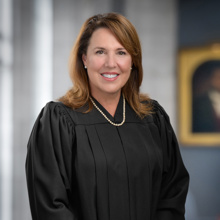
    Justice Verdin headshotJustice Letitia Hamilton Verdin — the daughter of Harry and Angela Hamilton — was born in Seneca, South Carolina. Her mother taught at her junior high school, and her father was her high school principal. She has two sisters, Felicia LeRoy and Blythe Hamilton.

    Justice Verdin graduated from Furman University in 1992 with a B.S. in biology. She also attended Clemson University for graduate school, studying biochemistry. She received her juris doctor from the University of South Carolina in 1997. While in law school, she was selected to be a member of the Moot Court Bar and National Moot Court competition team. She was also named the Outstanding Student Volunteer at the University of South Carolina School of Law for her work with domestic violence victims.

    After graduating from law school, she served as an Assistant Solicitor in the Office of the 13th Circuit Solicitor and, later, the Office of the 8th Circuit Solicitor. In this position, Justice Verdin prosecuted domestic violence cases and crimes against children. She also acted as the head of the Family Court unit for juvenile prosecution in both circuits. In 2000, she became an Associate Attorney with Clarkson, Walsh, Rheney & Turner, P.A. in Greenville, South Carolina. In this position, she practiced in governmental and general civil liability defense, criminal defense, and family law. In 2005, she returned to prosecution at the Office of the 13th Circuit Solicitor.

    In 2008, Justice Verdin was elected to the Family Court as a resident judge in the Thirteenth Judicial Circuit. Then, in 2011, the South Carolina Legislature elected her to the Circuit Court for the Thirteenth Judicial Circuit. As a Circuit Court judge, she served as President of the Circuit Judges’ Association, Chairperson of Judicial Standards, member of the Circuit Judges’ Advisory Council and member of the Commission on Continuing Legal Education.

    In 2023, she was elected to the Court of Appeals, and in 2024, the South Carolina Legislature elected her to be an Associate Justice of the South Carolina Supreme Court.

    Justice Verdin is a member of Liberty Fellowship and has taught as an adjunct professor at the Charleston School of Law. She is married to Chuck Verdin, a probate, estate and corporate attorney in Greenville, South Carolina. They have twin sons, Zack and Eli. The Verdins are members of Trinity Presbyterian Church in Travelers Rest, South Carolina.

Register to Attend

Registration is on a first come basis so register early!

Register Now