Research Focus & Programming
We promote forward-looking conservation supported by interdisciplinary training and translational research; strategic partnerships with a diverse array of stakeholders; and broad-based expertise in ecological science that generates solutions to environmental challenges. We are committed to extension and education that broaden participation in and disseminate an understanding of key sustainability issues to diverse audiences at the local, state, national, and international levels.
and their people.
Research Spotlights
Needs Assessment for Forest Landowner Recovery Following Hurricane Damage
Marzieh Motallebi, Joan Ureta, Robert Baldwin, and others
The main premise of this research is to understand how forest owners respond to hurricane damage on their woodlands, including the potential opportunities they could have for meaningful recovery, the potential shortcomings of financial and technical supports; and to investigate the ways in which the local, state, and federal agencies, in partnership with the non-profit and private sectors, could work together to aid family forest owner’s recovery from hurricane damage and prepare for future hurricanes. The focus of this study is forest owners who have been impacted by Hurricane Helene in 2024. The outcome of this study is to design decision support tools to help forest owners identify appropriate post-hurricane management strategies, and assess cost effectiveness of their future management plans. This project is funded by the USDA Forest Service. The Clemson PIs are collaborating with the USDA Forest Service and Appalachian State University to conduct this study.
Dr. Motallebi's Biography
Engaging Communities in Water Quality Protection
Dr. Amy Scaroni
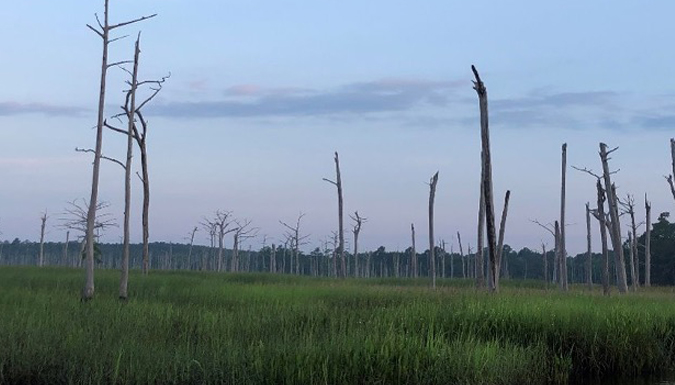
Before you can clean up water pollution, you first need to identify the source. Through a combination of water quality sampling, geospatial analysis, and community engagement, we are working with several communities to track down local sources of bacteria pollution. Largely assumed to come from failing septic tanks, we collect surface and groundwater samples, conduct lab analysis, and perform microbial source tracking to tie bacteria in the water to its original land-based source. From there, we work with communities to recommend projects, provide technical assistance, obtain funding, and we develop and share tools to aid in restoration.
Dr. Scaroni’s BiographyResearching Impoundments for Conservation Ecology
PI: Reed Goodman, Co-PIs: Tom O’Halloran, James Anderson
Researching Impoundments for Conservation Ecology (RICE) is a collaborative, interdisciplinary project turning South Carolina’s historic rice fields into living laboratories. By bringing together archaeologists, biometeorologists, and ecologists, we integrate sediment coring, archaeological trenching, and greenhouse-gas flux measurements to explore centuries of human and natural change from site to watershed. In Georgetown County, where the Waccamaw and Pee Dee rivers meet Winyah Bay, former plantation rice fields—created through the labor of enslaved people—preserve rich ecological and cultural layers. By aligning these records, the RICE project advances conservation outcomes, informs environmental adaptation, and supports heritage goals.
Dr. Goodman's Biography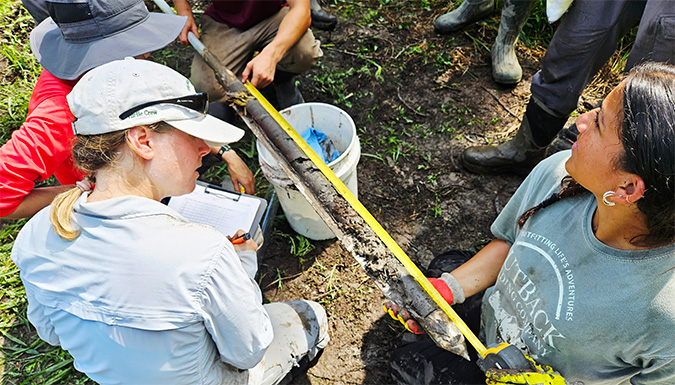
Retrofitting Rainwater Harvesting Cisterns with Passive and Active Release Systems
Dr. Sarah Waickowski, PE
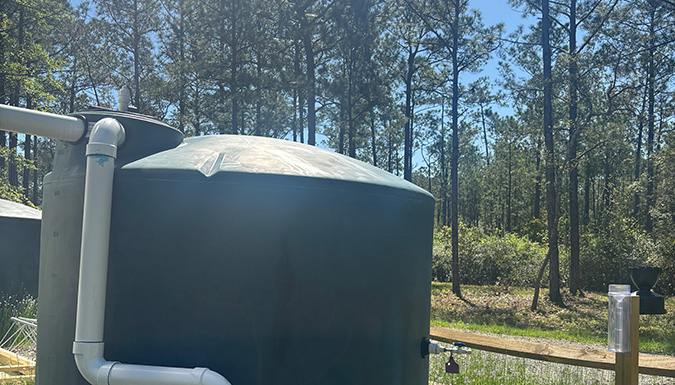
To address the problems associated with passive and active release retrofitting rainwater harvesting, this project is currently evaluating the hydrologic performance of a non-proprietary, active release mechanism that retrofits a cistern’s passive release system. The performance of the active release system is being compared to a cistern retrofitted with traditional passive drawdown. The cistern retrofitted with passive release has captured every storm event that has occurred thus far. The average drawdown rate is 6 gal/hr, and it takes approximately 55 hr for the tank to draw down volumes of stormwater it captures from the roof. The cistern retrofitted with active release has bypassed 435 gal of stormwater. The average delay is 26 hr. On average, the tank draws down captured stormwater over the course of 58 hr at a rate of 6 gal/hr.
Dr. Waickowski's Biography