Research Projects
Cryogenic Computing
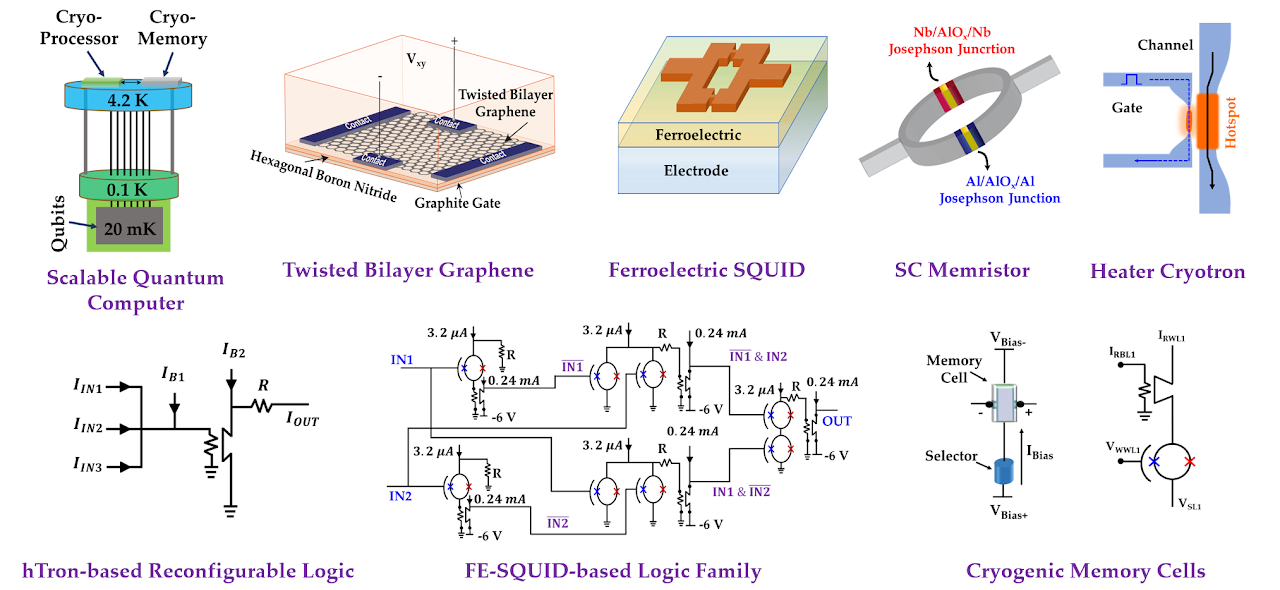
Cryogenic computing has emerged as one of the most promising alternatives to conventional CMOS technology thanks to its exceptional speed and energy efficiency. Beyond the classical computing paradigm, the need for suitable cryogenic processing and storage units is recognized in the field of quantum computing. Currently, in a quantum computer, qubits are placed at extremely low temperatures (tens of millikelvin) to protect their states from noise, while the peripheral components (control processor and memory) are at room temperature. This necessitates the use of a large number of long cables (for instance, 205 microwave cables for a quantum computer with tens of qubits). To unleash the full potential, the peripheral components must work at cryogenic temperatures to sit beside the qubits. Such a cryogenic processor can also improve the efficiency, reliability, and design complexity of spacecraft in aerospace exploration. In my research, I have utilized the unique properties of the quantum anomalous Hall effect (QAHE) observed in topological devices, including ferroelectric superconducting quantum interference devices (FE-SQUIDs), superconducting memristors, heater cryotrons, Josephson junctions, and Josephson junction FETs to develop suitable and scalable cryogenic memory and logic systems.
Beyond-CMOS Nanoelectronics
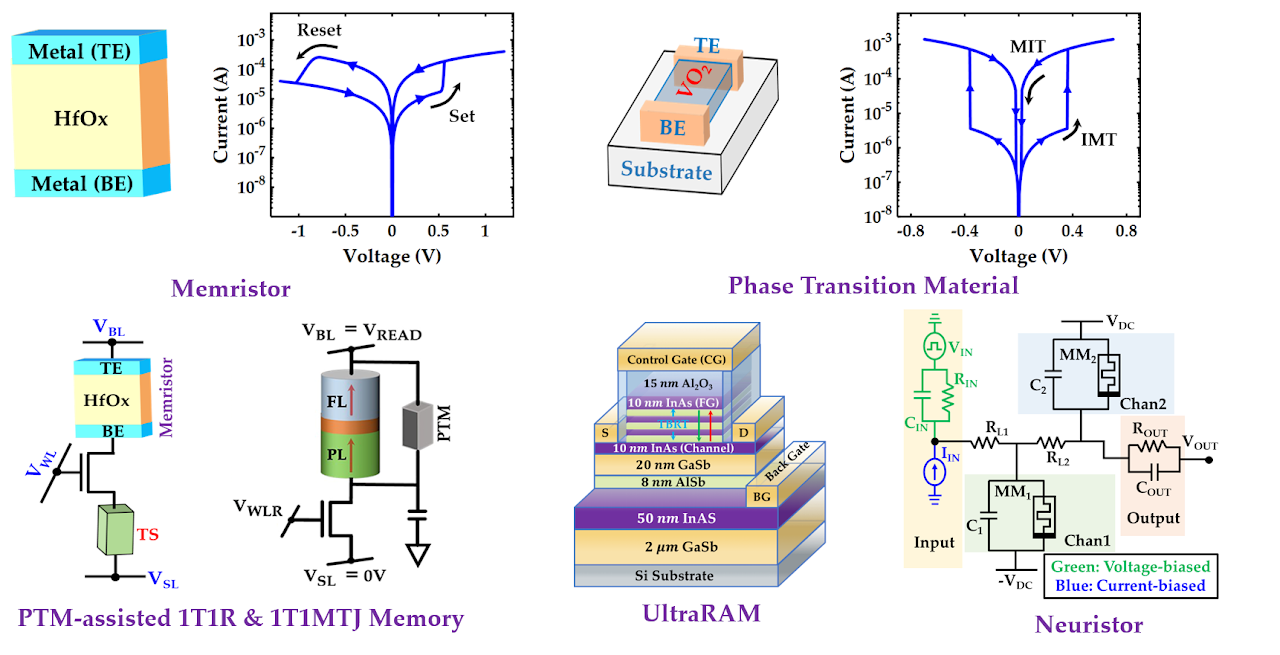
While Silicon-based complementary metal-oxide-semiconductor (CMOS) technology has undoubtedly achieved remarkable maturity, empowering us to integrate over a trillion transistors onto a single chip and unleash unprecedented computational power, it has simultaneously introduced intrinsic limitations as devices scale down in size, owing to the escalating influence of quantum-mechanical effects. These constraints present formidable obstacles, impeding further advancements in device and circuit performance and rendering them ill-equipped to meet the demands of cutting-edge, data-intensive applications, a challenge exacerbated by the relentless surge in data volumes. To surmount these constraints, my research explores 'beyond-CMOS' technologies to usher in a new era of computing platforms. These emerging technologies bring forth both unique advantages and complex challenges. My central research thrust centers on collaborative device and circuit design, representing the most promising avenue for harnessing the untapped potential of these novel technologies. In this regard, I have worked on memristors, ferroelectrics, and phase-transition materials to develop more robust memory and logic systems.
In-Memory Computing
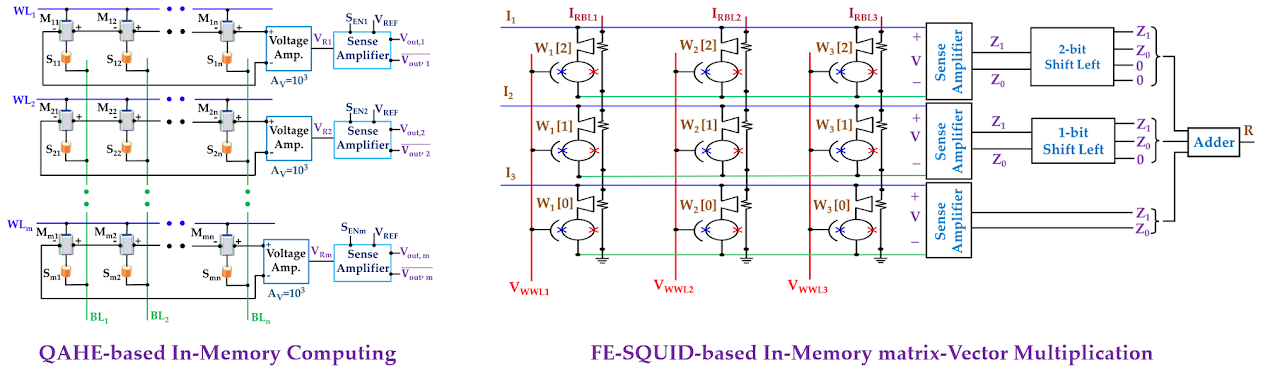
Efficiently managing the ever-expanding volume of data poses a formidable challenge for the electronics industry, primarily because traditional computers require constant data movement between memory and processing units. Google estimates that approximately 20-42% of energy is devoted to driving the data bus responsible for this data movement. Additionally, the inherent speed mismatch between memory and processing units significantly hampers overall system throughput. A promising solution to these challenges lies in in-memory computing systems, where computational tasks are executed within the memory array itself. In my research, I have worked with memristive and ferroelectric memory arrays to develop room-temperature in-memory computing systems. I have also worked on cryogenic in-memory computing, as in-memory computing in a cryogenic environment offers a unique advantage: reduced cooling costs. I have developed in-memory computing platforms that perform Boolean logic operations, bit-serial addition based on majority logic, binary multiplication, content-addressable memory, matrix-vector multiplication, and ternary computing.
Other Areas
- Design of Peripheral Components for Quantum Computing
- Neuromorphic Computing
- Artificial Intelligence Hardware
- Probabilistic Computing
- Hardware Security
