Doctor of Philosophy in Communication and Media Overview
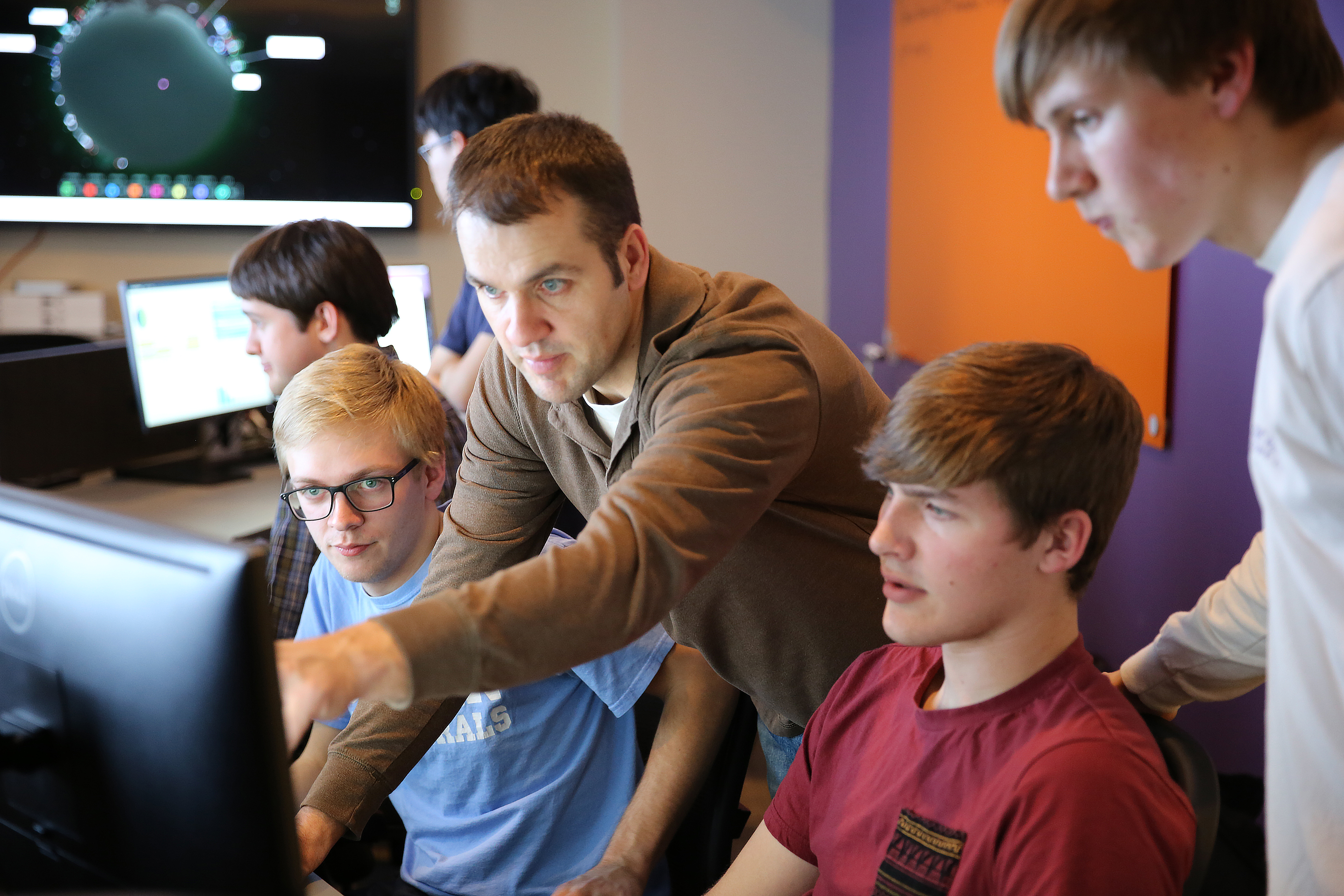
The Ph.D. in Communication and Media provides comprehensive training in both theory and methods, with a keen focus on applying these principles to an array of real-world problems and issues. With an ever-increasing proliferation of digital media platforms and AI systems that perform narrative intelligence tasks, the demand for experts to conduct research, offer curriculum, and put into practice skills related to these broader contexts of communication and media is critical. The program prepares graduates to succeed as leaders in an increasingly globalized and digitized world.
For more information about the Ph.D. in Communication and Media, please contact.
Greg Cranmer
Graduate Programs Coordinator
gcranme@clemson.edu
Area of Study
The Ph.D. in Communication and Media cultivates an appreciation for the breadth and depth of inquiry in communication and media. In line with the Department of Communication’s mission, students will be afforded opportunities to collaborate with world-renowned faculty and peers to conduct research in areas related to communication and media (e.g., health communication, strategic communication, organizational communication, sports communication, risk and crisis communication, instructional communication, media and technology).
-
Apply
Prerequisites
Applicants must have a background in Communication or a relevant discipline, and present evidence of such competence via transcripts and supporting materials. Applicants must have a Bachelor’s and Master’s Degree in Communication or a relevant discipline in hand by the time they begin the program. The ad hoc committee may permit exceptions on a case-by-case basis.
English Language Proficiency
International students whose native language is not English are required to submit a high score on the Test of English as a Foreign Language (TOEFL) or Pearson Test of English (PTE). International students who are applying for a graduate assistantship are encouraged to submit scores from the Test of Written English (TWE), which is administered simultaneously with the TOEFL at most locations. TOEFL/PTE exams may be no more than two (2) years old.
Applicants requesting a TOEFL/PTE waiver must complete the Request for English Proficiency Waiver form at https://gradapply.clemson.edu/register/langprofwaiver.
ELP requirements for an applicant can be waived for the following reasons:
- Previous employment in the U.S. (Length of time + letter from employer/must have been in the last two years)
- Extended residency in the U.S. (length of time + how English has been used daily/ must have been in the last two years)
- Earned or in-progress undergraduate or graduate degree from a regionally accredited U.S. institution
- Earned or in-progress degree from a foreign institution where English is the only language of instruction
The Department of Communication does not facilitate these waivers and cannot approve them. Please contact the Clemson University Graduate School using the link above to initiate your request.
In some cases, the department may assign non-native English speakers to teaching assistantships that involve only one-on-one tutoring until they are deemed ready for classroom teaching. If you are a current student and a non-native English speaker, and your graduate advisor feels you should improve your English skills, you must complete English 1110: English as a Second Language or an approved course from one of Clemson’s ESL affiliates.
Computer Proficiency
The Ph.D. has no formal requirements for computer literacy or competency. However, each graduate student is expected to be proficient in the use of computers. Use of computers and competency in various software programs will be necessary in many graduate courses and, in most cases, in both your teaching and research, and it is expected that you will acquire whatever skills are needed to use these resources as they are required. Many workshops provided by various Clemson groups regularly present opportunities for students to gain and advance their computer skills. Typically, students should expect to produce work using a word processing software (such as Microsoft Word) and presentation decks using slide software (such as Microsoft PowerPoint).
Campus Visits
Ph.D. applicants are encouraged to visit Clemson if possible. We will be happy to organize department and campus tours, as well as meetings with current faculty and students. Contact the Doctoral Program Coordinator to arrange your visit. If you cannot physically visit Clemson, we are glad to meet with you via Zoom.
Duplicate Degrees
Individuals who hold a doctoral degree in a similar field, received at another institution, may not become a candidate for another doctoral degree in the same field at Clemson. If you have questions about whether your existing doctoral degree is considered a duplication with the Ph.D. in Communication and Media, please contact the Doctoral Program Coordinator.
South Carolina Residency
Many students are interested in establishing residency in South Carolina for the purpose of paying in-state tuition. The South Carolina residency laws call for you to establish legal ties with the state; you must generally wait one year before establishing legal ties. Thus, you should take steps near the beginning of your program to initiate the process of becoming a South Carolina resident.
The legislation defining residency sets forth a strict set of criteria for the administrative approval of residency requests. The Office of Residency Classification handles all the information regarding domicile requirements for residency status. Due to the frequency of changes implemented by the state legislature in past years, those criteria are not elaborated here. If you are interested in establishing South Carolina residency, review the up-to-date information at https://www.clemson.edu/financial-aid/cost/residency/. Questions should be addressed to the Office of Residency Classification (G-01 Sikes Hall, 864-656-2280).Deadlines
Applicants seeking full-time enrollment, tuition waiver, and a stipend must apply for fall admission. Initial review of applications begins February 1, with rolling admission through March 1. Applications submitted after March 1 will likely not be considered for the fall admission period. Initial offers are typically made by the end of March.
Applicants who have been made initial financial offers have until April 15 to reject or accept that offer. Students may be placed on a wait list for admission and/or assistantships. If no response is received at that point, their offer will be given to another applicant.
Students may enter spring semester. Applicants seeking spring admission must apply by September 30 for the following spring semester. Initial offers are typically made by the end of October. Spring applications may be rejected, accepted for spring, accepted for the following fall, or rolled over into the applications to be reviewed for the following fall.
Applicants interested in part-time enrollment can apply for either deadline but must indicate this in their personal statement. Part-time students are NOT eligible for tuition waiver or assistantship stipend.
We will continue to review all applications past the March 1 for Fall admission and September 30 for Spring admission deadlines. Applicants may apply past these deadlines, but their applications will not be given priority.Ph.D. Application Process
Admission to the Ph.D. in Communication and Media begins with your submission of an official application to the Graduate School via their website, beginning here: https://www.clemson.edu/graduate/admissions/apply/Upon receipt of all admission materials, the Graduate School will forward your application to the Department of Communication for review. Applicants must meet all admission requirements of the Graduate School, the Department of Communication and the Ph.D. program before official acceptance will be considered. Only applications that are formally submitted through the Graduate School are eligible for review.
Ph.D. Application Components\
All components of the applications are fully considered. Required components include:
- A personal statement (1,000-word limit, double-spaced) noting desired semester entry, full- or part-time status, and desire for assistantship. Statement should contain focused reasons for wanting to attend Clemson and the Ph.D. program, such as faculty, research programs and centers, local resources and opportunities, etc. Emphasize and describe your experiences, goals, reasons for pursuing this degree, and unique contributions you can make to the program, as well as any existing research experience or history of working independently.
- A curriculum vita (no minimum page length) detailing education, employment, any relevant research experience, volunteer and service work, mailing address, email address, phone number, and links to any online projects.
- Up to two writing samples (approximately 25 pages each) demonstrating scholarly/academic writing that shows understanding of theory and methods. Do not send professional writing, such as press releases or news articles.
- Bachelor’s degree and master’s degree from an accredited college or university earned by the time you begin the program.
- Transcripts from all universities or colleges from which you graduate. For the application, transcripts can be unofficial, but applicant must provide official transcripts once admitted.
- Three letters of recommendation.
- We do not require students to take the GRE for consideration in our program. Submitting official scores is optional. Clemson’s Institution Code is 5111. GRE exams more than five (5) years will not be accepted.
- English-language test scores described previously if applicable.
Desirable qualities: Applications are considered holistically, however, invited students typically fall within these parameters:
- Grade Point Average of 3.0-4.0 (on a 4.0 scale)
- Clear articulation of connection to our program’s emphasis areas, clear fit with faculty, and a desire to work with our specific faculty and/or our specific resources
- All letters of recommendation from academic sources (not employers or acquaintances)
International Students
See the Graduate School Policies & Procedures Handbook.
International Ph.D. Applicants
Clemson’s Office of Global Engagement has an International Services department to assist with the unique concerns of international students: https://www.clemson.edu/campus-life/campus-services/international/
Forms for international applicants and students can be found here: http://www.clemson.edu/campus-life/campus-services/international/forms.html
International students seeking admission to Clemson University under F-1 or J-1 visa status are required to provide proof of sufficient financial support for at least one academic year before a Certificate of Eligibility can be issued. U.S. federal regulations require universities to verify that students entering the U.S. on F-1 and J-1 visas have adequate financial resources to meet educational and living expenses.
Financial documentation must be submitted through the iStart Portal and include the International Student Financial Certification Form and must demonstrate that the student has access to the minimum required funding for one (1) academic year upon arrival in the U.S. The Form I-20 for F-1 students or the Form DS-2019 for J-1 students cannot be issued until Immigration Services receives and approves all required financial documentation verifying the availability of adequate funds. A link to the portal can be found on this page: https://www.clemson.edu/campus-life/campus-services/international/forms.html
All submitted financial documents must be current and bear original signatures. Failure to provide acceptable proof of funding will delay the issuance of immigration documents and the student’s visa application process.
Submit all required materials by November 15 for spring enrollment, April 1 for summer enrollment, and July 1 for fall enrollment. Students transferring a SEVIS record from another U.S. institution must complete their certificate of eligibility request by the start of classes for their intended term.
If you have any questions concerning the submission of financial documents, contact Immigration Services at is@clemson.edu or (864) 656-3614.
Please note Clemson University requires all fees to be paid on the first day of late registration. Loans and deferred payments generally are not available to international students. Tuition and fees may increase without prior notice.
Ph.D. Application Decisions
Upon your completion of the online application, your application status can be checked at https://www.clemson.edu/graduate/admissions/application-status.html. The Doctoral Program Coordinator and the Graduate Committee examine your application packet and make recommendations as to whether you will be offered admission to the program. Then in consultation with the Department Chair, a decision will be made on your application. The Graduate School will then notify you of your acceptance as well as any existing provisions. If you are not considered acceptable for admission, the Doctoral Program Coordinator will indicate this in the admissions database and the Graduate School will send you a letter of rejection. You may appeal the rejection to the Graduate School.
Ph.D. Acceptance Categories
Students are accepted into the program as either full or conditional status. Each indicates a different level of performance on the admission criteria.
Full Status: Your credentials equal or exceed every minimum admission criterion prescribed for the applied-for degree.
Conditional Status: At least one piece of required application materials has not been received by the Graduate School. Notice of conditional acceptance may be given prior to receipt of a missing item, but any and all missing materials must be received prior to or during your first semester of enrollment. Upon receipt, you may be admitted to either full or conditional status. Conditional status may also be granted to highly qualified applicants prior to receipt of the degree they are currently pursuing; however, all requirements for that degree must be completed prior to enrolling in the proposed graduate program at Clemson.
If an applicant is conditionally accepted pending completing certain course deficiencies specified as a condition of admission, it is important that they take the necessary courses early in the program to provide them with background for graduate-level courses. Normally, they will remove these deficiencies by taking and passing the required courses during a regularly scheduled course offering. These courses do not count toward the total number of semester hours of graduate credit required for graduation.
Notification of Ph.D. Decision
For Fall: Once invited into the Ph.D., a student has until April 15 to notify the Doctoral Program Coordinator of their intent to accept admission into the program and the financial offer that accompanies the offer of admission (a teaching assistantship, research assistantship, grant, fellowship, or offer of employment). This is a fixed deadline for the financial offer, honored nationally by over 200 graduate schools, so no extensions will be allowed. Once this commitment is made by a student, it is binding, and the student should not be accepting a financial offer from any other institution. Clemson will not offer funding and admissions to any students who have made commitments to other institutions. An invited student may defer admission for one year but must notify the Doctoral Program Coordinator of that decision by April 15. Students who do not notify the Doctoral Program Coordinator of a decision by April 15 are assumed to have declined the offer, and their position in the program may be offered to a waitlisted student.
For Spring: Once invited into the Ph.D. in Communication and Media, a student has until November 15 to notify the Doctoral Program Coordinator of their intent to accept admission into the program. An invited student may defer admission for one year but must notify the Doctoral Program Coordinator of that decision by November 15. Students who do not notify the Doctoral Program Coordinator of a decision by November 15 are assumed to have declined the offer, and their position in the program may be offered to a waitlisted student. -
Degree Requirements
Overview
- Total hours of coursework: 64 hours
- Core hours: 25 hours
- Elective courses required: 21 hours
- Comprehensive exams: 3 hours (included in Core hours)
- Dissertation Research: Minimum of 18 hours
Candidates for the PhD in Communication must complete a minimum of 64 credit hours, including the following core courses (unless a similar course was previously taken and accepted by the Doctoral Program Coordinator or Department Chair):
- COMM 8000: Communication Pedagogy (1 credit)
- COMM 8200: Foundations of Communication (3 credits)
- COMM 8110: Qualitative Research Methods (3 credits)
- COMM 8100: Quantitative Research Methods (3 credits)
- COMM 8270: Communication Education (3 credits)
- COMM 8130: Theory Construction in Communication (3 credits)
- COMM 8250: Professional Seminar in Communication (3 credits)
- COMM 8140: Advances in Communication Research Methods (3 credits)
- COMM 8800: Directed Readings in Communication (3 credits)
Elective Courses
A minimum of 21 elective credits must be taken in Communication and/or another field. Students may take up to 3 credit hours of COMM 8900: Internship or COMM 8990: Independent Study to fulfill elective requirements. You may not take both an Internship and an Independent Study as part of your degree. The number of elective courses you take in a specialty area will depend on whether you are participating in the thesis option or the comprehensive exam option. Your doctoral advisor will help you select courses that meet your goals.
Comprehensive Exams
The exam committee will be selected in consultation between the student and their Doctoral Advisor and be composed of Graduate Faculty from the Department of Communication but may also include faculty representing associated disciplines on the Clemson campus, or other professionals deemed relevant. A minimum of two of the committee members must be Graduate Faculty from the Department of Communication.
Dissertation Requirements
Students may choose from two dissertation options: monograph or article-based.
-
Course List
COMM 8000: Communication Pedagogy (1 credit hour, repeatable): A one-credit course, taken each semester by graduate teaching assistants, that fosters development of teaching skills within the field of communication, focusing on the teaching of general education courses. Explores the facilitation of a positive classroom environment, addressing student needs and evaluating student work. Discussion of teaching philosophy and pedagogy.
COMM 8100: Quantitative Research Methods in Communication (3 credit hours): Explores methods of social scientific research methodologies. Methods range from experimental designs to survey and cross-sectional designs. Final projects will include the employment of one or more methodologies for a communication-based research study.
COMM 8110: Qualitative Research Methods in Communication (3 credit hours): Exploration of select issues and methods for qualitative research. Students discuss and practice data gathering and analysis techniques associated with ethnographic, interview, and textual approaches.
COMM 8130: Theory Construction in Communication (3 Credit Hours): This seminar explores the history and current state of theory construction in the communication discipline. Students enrich their understanding of philosophies grounding communication as a social science, as well as various metatheoretical perspectives, theory-building processes, and evaluative measures. (Prerequisites: None)
COMM 8140: Advances in Communication Research Methods (3 Credit Hours): Trains students to apply advances in research methods specific to the Communication discipline, going beyond what is addressed in the department’s fundamental Quantitative and Qualitative Research Methods courses. Topics may range from qualitative, quantitative, and mixed methods, as well as computational methods, big data analytics, neuroscience, and applications of artificial intelligence in Communication research. (Prerequisites: None)
COMM 8200: Foundations of Communication (3 credit hours): Introduces students to graduate study in communication and provides students with the necessary skills to comprehend, evaluate, and build upon communication scholarship.
COMM 8210: Seminar in Strategic Communication (3 credit hours, repeatable): Explores topics related to theory and research in the area of strategic communication, including campaigns, crisis, risk, or social media. Specific topics covered may vary by semester or instructor. May be repeated for a maximum of six credits. Recent seminar topics have included: Social Media Strategy, Public Relations Theory
COMM 8220: Seminar in Sport Communication (3 credit hours, repeatable): Examines topics related to the academic study of sport communication. May include human communication processes, journalism, media effects, identity formation, or fandoms. Specific topics covered vary by semester. May be repeated for a maximum of six credits. Recent seminar topics have included: Sport and Health Communication.
COMM 8230: Seminar in Media and Technology (3 credit hours, repeatable): Examines research and theory related to topics in media and technology as they relate to the pluralistic field of communication. Topics vary by semester. May be repeated for a maximum of six credits. Recent seminar topics have included: Communication Infrastructures, Digital Communication.
COMM 8240: Seminar in Health Communication (3 credit hours, repeatable): Explores issues related to the interdisciplinary work of health communication from social scientific and/or humanistic perspectives. Particular topics covered may change by semester. May be repeated for a maximum of six credits. Recent seminar topics have included: Persuasive Technologies; Health Campaigns
COMM 8250: Professional Seminar in Communication (3 Credit Hours): Prepares students for multifaced professional roles as a Communication faculty in contemporary higher education environments, as well as Communication professionals in the private sector. Students gain an understanding of the various responsibilities associated with faculty jobs, including the peer-review process, grant writing, developing research agendas, networking, collaborating, and career development. They will also engage in intellectual discussions with Communication professionals in the private (for-profit and nonprofit) sector to understand the utility of their doctoral studies to that world beyond graduation. (Prerequisites: None)
COMM 8720: Seminar in Communication Education (3 credit hours): Explores communication education and related fields of study, such as instructional communication and critical communication pedagogy.
COMM 8740: Special Topics in Communication (3 credit hours): Varying topics within the field of communication. May be repeated for a maximum of six credits, but only if different topics are covered.
COMM 8800: Directed Readings in Communication (3 credit hours): Directed reading and research in the student’s area of interest in preparation for the comprehensive exam. To be taken Pass/No Pass only.
COMM 8900: Communication Graduate Internship (3 credit hours): Preplanned, preapproved, faculty-supervised internship provides communication graduate students with field experience in areas related to their curriculum. Provides an applied component to the advanced study of communication theory and professional development for industry and research careers.
COMM 8910: Master’s Thesis Research (1-6 credit hours): Students complete research toward production of a Master’s thesis. A maximum of six hours may be applied toward a degree, though additional hours may be taken for credit. Preq: Successful completion of core program requirements and all additional courses as approved by the department's Graduate Programs Coordinator.
COMM 8980: Colloquium (1 credit hour, repeatable): A one-credit course, taken each semester, that consists of individual and panel-style lectures by faculty, students, or outside speakers that discuss different areas of communication, graduate study, and resources at Clemson. Particular attention is given to professional development.
COMM 8990: Independent Study (1-3 credit hours): Tutorial work for graduate students with special interests or projects in communication outside the scope of existing courses. May be repeated for a maximum of three credits.
-
Assistantship Opportunities
Assistantships provide a full tuition waiver and a monthly stipend for the academic year (nine months). All applicants for full-time admission are considered for an assistantship unless they indicate otherwise. Assistantships are awarded on the availability of funds each year.
Teaching assistantships generally involve our basic communication courses. Graduate teaching assistants develop communication and leadership skills as they help students in the Communication Lab with composing and delivering speeches. They also gain valuable teaching experience by leading their own discussion sections (labs) with the support of our departmental faculty. A one-week training program is delivered before the start of classes in the fall semester, along with weekly support meetings.
Research assistantships can involve working one-on-one with faculty members, projects or teams. Graduate research assistants gain hands-on experience with the research process through data collection, analysis, presenting and/or writing the final research report. Collaborative projects with faculty typically result in co-authored conference presentations and publications in academic journals.
Assistantships are evaluated and renewed after one year based on performance and academic standing.
