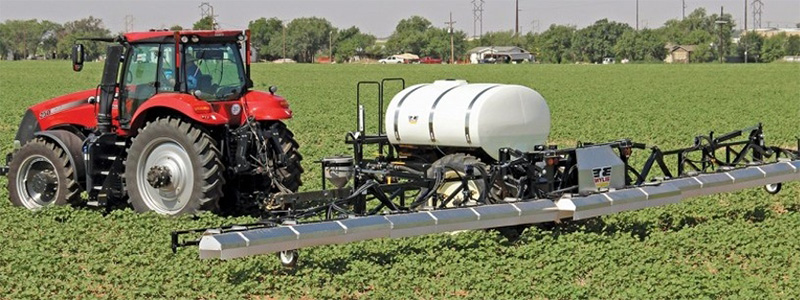
Sprayer calibration is the process of ensuring that your spray equipment is prepared to deliver the correct volume of liquid carrier in the proper spray pattern required for the field being treated. In order to avoid improper or wasteful use of herbicides, it is important that proper calibration of application equipment is completed regularly.
Calibration Guide
1) Check nozzle operation and spray pattern
Make sure nozzles are operational & pattern is a good fit for upcoming application
2) Determine nozzle output at standard 40psi
Measure output by spraying water through nozzle for 15 seconds
Fluid ounces (fl oz) collected can be used to calculate spray rate
Multiply by 4 to determine fl oz per minute
Divide by 128 to determine gallons per minute, or GPM (as 128 fl oz comprise 1 gal)
Repeat this process for all nozzles on sprayer
3) Determine tractor/walking speed
Speed of over specific distance based on nozzle spacing or band width
Record time required to travel distance to obtain speed, convert to mph
Broadcast Spraying
GPA = Average ounces per nozzle in seconds required to cover course.
Calibration Course
*Note that in a directed spray situation, where you may have three nozzles applying the spray to one row, collect the output from all three nozzles
Nozzle spacing (inches)
Course Length (feet)
12
340
16
255
20
204
24
170
28
146
32
128
36
113
40
102
Boom Sprayer
Select a course length based on nozzle spacing (from chart below).
Nozzle spacing (inches)
Course Length (feet)
120
204
22
185
24
170
26
157
28
146
30
136
32
127
34
120
36
113
38
107
Boomless Sprayer
Select a course length based on spray swath width (from chart below).
Spray Width (feet)
Course Length (feet)
30
182
32
171
34
161
36
152
38
144
40
137
42
130
44
124
4) Calculate sprayer output
Sprayer output in gallons per acre (GPA) obtained by entering values for nozzle output in gallons per minute (GPM), speed (mph), and nozzle spacing (in) into the formula:
GPA = (5940 x GPM) / (speed x sprayer width)
(5940 x _gal / min) / (_mph x _in)
5) Determine if sprayer output is appropriate for herbicide product
Consult herbicide label for information regarding appropriate output rate for the recommended mixture of the product
Changes in sprayer range can be made by recalibrating sprayer
Large changes in sprayer output can be made by changing nozzle size
Small changes in sprayer output can be made by changing pressure from the standard 40psi, though doing this will require recalculating nozzle output and sprayer output
6) Calculate total spray mixture volume
Spray mixture volume =
(sprayer output) x (treated area)
(_gal / acre) x (_acre)
7) Determine area covered by one full spray tank
Treated area covered by full spray tank =
(sprayer tank capacity) / (sprayer output)
(gal) / (GPA)
8) Preparing spray mixture
Treated area covered by one full spray tank x herbicide rate from label
(_gal / acre) x (_oz/pt/gal / acre)
Scale up for full coverage of treated area if necessary
Example Problems
A quarter acre field infested with yellow nutsedge is to be treated with halosulfuron-methyl (Sandea) in order to prepare for watermelon transplants.
If your sprayer has nozzles with 18 inch spacing, a nozzle output of .33 gpm and you move at a 3 mph pace, how many gallons per acre of formula can you apply?
What is the total volume of formula that needs to be applied to this field?
If the sprayer tank can hold 65 gallons, how much of the field can one tank cover?
How much Sandea needs to be used in order to treat the field?
A field known to contain seed from a number of highly problematic weeds is to be treated with s-metolachlor (Dual Magnum) in preparation for tomato transplants.
If your sprayer has nozzles with 20 inch spacing, a nozzle output of .27 gpm and you move at a 2 mph pace, how many gallons per acre of formula can you apply?
What is the total volume of formula that needs to be applied to this field?
If the sprayer tank can hold 50 gallons, how much of the field can one tank cover?
How much Dual Magnum mixture needs to be made to treat the field?
20 acres of land infested with palmer amaranth and common purslane is to be treated with fomesafen (Reflex) in preparation for an upcoming bell pepper planting.
If your sprayer has nozzles with 21 inch spacing, an average output of .42 gpm and you move at a 2.5 mph pace, how many gallons per acre of formula can you apply?
What is the total volume of formula that needs to be applied to this field?
If the sprayer tank can hold 100 gallons, how much of the treated area can one tank cover?
How much Reflex needs to be added to the tank in order to treat the field?
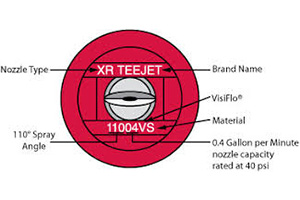
Nozzle Diagram
Example Problem Solutions
A quarter acre field infested with yellow nutsedge is to be treated with halosulfuron-methyl (Sandea) in order to prepare for watermelon transplants.
If your sprayer has nozzles with 18 inch spacing, an average output of .33 gpm and you move at a 3 mph pace, how many gallons per acre of formula can you apply?
Nozzle width = space between nozzles
= 18 in
GPA = (5940 x gpm) / (nozzle width x speed)
= (5940 x .33 gpm) / (18in x 3mph)
= (1960) / (54)
= 36.2 gallons per acre
What is the total volume of formula that needs to be applied to this field?
Spray mixture volume = (sprayer output) x (treated area)
= (36.2 gpa) x (0.25 acres)
= 9.1 gallons
If the sprayer tank can hold 65 gallons, how much of the field can one tank cover?
(sprayer capacity) / (sprayer output)
= (65 gal) / (36.2 gpa)
= 1.8 acres per tank
How many tanks will be needed to treat the whole field
(0.25 acres) / (1.8 acres/tank) = 0.14 tank
How much Sandea needs to be added to the tank in order to treat the field?
Treated area x herbicide rate (on label & in management section)
(0.25 acres) x (0.75 oz)
= 0.19 oz Sandea + enough water to reach 9.1 gal
A field known to contain seed from a number of highly problematic weeds is to be treated with s-metolachlor (Dual Magnum) in preparation for tomato transplants.
If your sprayer has nozzles with 20 inch spacing, an average output of .27 gpm and you move at a 2 mph pace, how many gallons per acre of formula can you apply?
Nozzle width
20in
GPA = (5940 x gpm) / (nozzle width x speed)
(5940 x .27 gpm) / (20in x 2mph)
= (1603.8) / (40)
= 40.1 gpa
What is the total volume of formula that needs to be applied to this field?
Spray mixture = (sprayer output) x (treated area)
= (40.1 gpa) x (2 acres)
= 80.2 gal
If the sprayer tank can hold 50 gallons, how much of the field can one tank cover?
Tank coverage = (sprayer capacity) / (sprayer output)
= (50) / (40.1)
= 1.25 acres
How many tanks will be needed to treat the whole field?
(2 acres) / (1.25 acres/tank) = 1.6 tanks
How much Dual Magnum mixture needs to be added to the tank to treat the field?
Treated area x herbicide rate
(2 acres) x (1.5 pt/acre) = 3 pt Dual Magnum total + enough water to reach 80.2 gal
For practical purposes, can do 2 tanks of 1.5 pt Dual Magnum + enough water to reach 40.1 gal
20 acres of land infested with palmer amaranth and common purslane is to be treated with fomesafen (Reflex) in preparation for an upcoming bell pepper field.
If your sprayer has 30 inch spacing, an average output of .42 gpm and you move at a 5.5 mph pace, how many gallons per acre of formula can you apply?
Nozzle spacing
30 in
Sprayer output (GPA) = (5940 x gpm) / (width x speed)
= (5940 x .42) / (30 in x 5.5)
= (2494.8) / (165)
= 15.12 gpa
What is the total volume of formula that needs to be applied to this field?
Mixture volume = (sprayer output) x (treated area)
= (15.12 gpa) x (20 acres)
= 302.4 gallons
If the sprayer tank can hold 100 gallons, how much of the treated area can one tank cover?
(sprayer capacity) / (sprayer output)
(100 gal) / (15.12 gpa)
= 6.61 acres per tank
How many tanks will be needed to treat the whole field
(20 acres) / (6.61 acres per tank)
= 3.03 tanks (~3 tanks)
How much Reflex needs to be added to the tank in order to treat the field?