CU-ICAR is an advanced research campus where education, research and corporate engagement create a global venue for public/private partnerships. Our internationally recognized $250 million campus was developed in collaboration with BMW, Michelin, Timken, and the state of South Carolina. The campus includes full-scale automotive testing equipment, graduate education programs in automotive engineering and facilities that bring industry and Clemson University researchers together to provide solutions for sustainable mobility.
Focus Areas
We continuously analyze the market and survey industry leaders to identify future trends and R&D focus. Based on this knowledge, our research clusters and “technology identity” are centered in five research areas.
-
Advanced Vehicle Propulsion Systems
Advanced powertrain systems research focuses on reducing the environmental impact of ground vehicles. At CU-ICAR, we cover a wide range of research topics utilizing world-class computational and experimental facilities.
Propulsion system architectures, including hybrid electric systems and simulation-based methods for optimization of design and operating strategy, advanced IC engine concepts and control, emissions after treatment modeling and control, alternative fuels, heat transfer and low-heat rejection, energy storage systems, power electronics, battery aging and management systems along with the vehicle to grid interaction, model-based powertrain control and algorithms for improving energy efficiency using vehicle connectivity.
Students who choose to specialize in this area will study several topics related to reducing the environmental impact and cost of ground vehicle powertrains. Courses offered in this area include a mix of fundamental principles, modeling and simulation, control system development, powertrain calibration, sub-system and component design, and extensive laboratory experiences.
Primary Contact
Rob Prucka
Chair and Alan Kulwicki Professor of Motorsports Engineering
rprucka@clemson.edu -
Advanced Manufacturing & Materials
Research in manufacturing and materials is focused on new manufacturing systems, continuous process improvement, sustainable manufacturing, and advanced materials, including characterization, processing, and manufacturing.
Research that focuses on the digitization of manufacturing systems, vehicle assembly, automation and human-robot interaction, data analytics and predictive maintenance, continuous process improvement, sustainable manufacturing and advanced materials, metal and non-metal, characterization, processing, and manufacturing.
Automotive engineering students who choose this area for their technical track will participate in a number of academic and research activities related to production systems, manufacturing process development, and advanced materials.
Primary Contact
Laine Mears
SmartState Endowed Professor of Automotive Manufacturing
mears@clemson.edu -
Design & Integration of Complex Systems
Our definition of systems integration is an interdisciplinary, collaborative engineering-and-management approach that produces an integrated solution that satisfies all customer needs. This includes developing system-engineering processes and tools to connect the product/service under development with policies, legislation, and market factors, while carefully balancing manufacturer/operator requirements with user expectations/limitations and product/service properties, geometry, cost, and weight.
An interdisciplinary, collaborative engineering and management approach that produces an integrated solution that satisfies all customer needs. Modeling and simulation tools for full-vehicle prototyping and agile trade space exploration by combining efficient optimization and rapid analysis. Agile physical prototyping of innovative vehicle concepts.
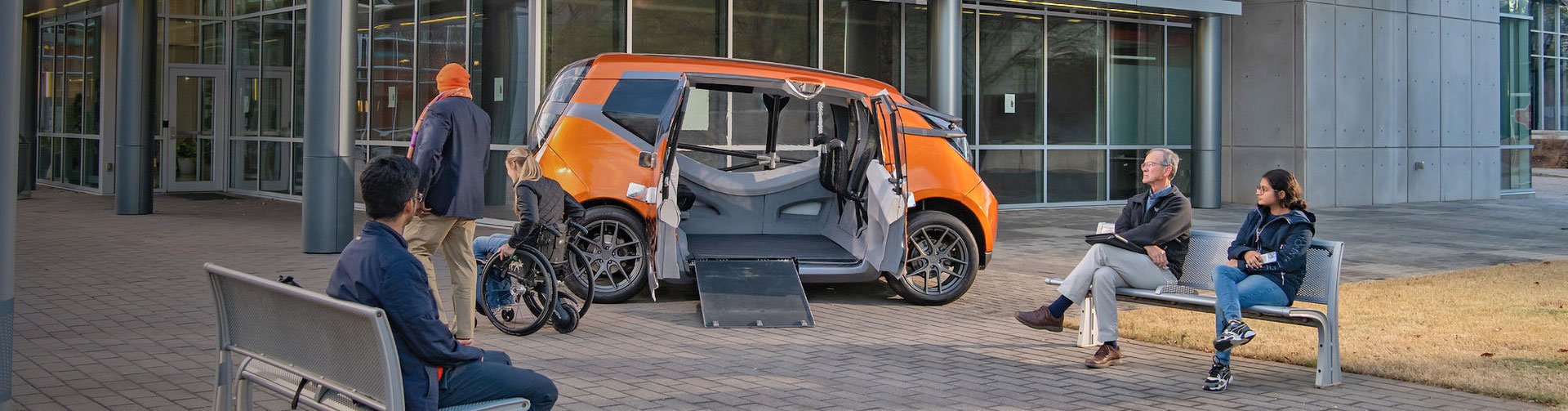
The Deep Orange Vehicle Prototyping Program is an integral part of the automotive graduate program. Deep Orange aims to place this knowledge into context and tackle complex problems by collaborating with colleagues whose perspectives are shaped by radically different experiences. During the two-year M.S. program, students, faculty, and participating industry partners will develop and manufacture a vehicle prototype, giving students experience in marketing, design, engineering, systems integration, prototyping, and production planning from their entry into the program until graduation.
Primary Contact
Michael Kokkolaras
Chair
mkokkol@clemson.edu -
Connected & Automated Vehicles
Modern-day Connected and Automated Vehicles (CAV) serve as exemplars of distributed, networked Cyber-Physical Systems-of-Systems (CPS) with immense diversity, scale, scope and complexity. Our CAV faculty’s research explores various facets of design, modeling, analysis, control, and validation of distributed and networked cyber-physical systems (small- to full-scale vehicles, energy systems, EVs, HEVs, robotics/automation) across numerous application arenas. Our unique and innovative research blends computational/virtual-prototyping approaches (digital twins, visualization, data fusion, data science, and artificial intelligence) with embodiment/physical-prototyping approaches (nonlinear estimation & control, mechatronic realization, verification & validation) to further the cyber-physical system paradigm.
Lifecycle treatment (design, analysis, prototyping, validation, operation, and end-of-life) of multi-scale distributed connected-autonomy systems-of-systems to enhance and empower mobility and improve energy efficiency and traffic flow. Application areas range from microcosms of Smart Cities, such as manufacturing shop floors, malls, and hospitals, to full-scale smart city settings. Research activities explore the use of cutting-edge techniques from multi-body dynamics, nonlinear estimation and control, data augmentation & artificial intelligence, high-performance computing, and X-in-the-loop (XIL; X = software/hardware at component, subsystem, system, system-of-systems) to support these efforts.
Students who select Connected and Automated Vehicles for their technical track will participate in a number of academic and research activities related to conceiving, prototyping, deploying, and validating such CAVs across varying physical scales and operational design domains with applications in on-road, off-road, and manufacturing shop-floor settings.
Primary Contact
Venkat Krovi
Chair & Professor
vkrovi@clemson.edu -
Human Factors
Human Factors/HMI integrates multiple disciplines, including psychology, medicine, computer science and engineering, to maximize usability and user satisfaction with existing products and innovations. The human factors/HMI research team strives to understand human capacities and limitations better. The team uses this information to create and improve tools and systems that maximize usability and user experience.
Clemson's automotive engineering program is unique because it integrates a psychologist, a computer scientist, and a business expert into the program. By integrating human factors, HMI, and business principles into the curriculum, students gain an appreciation for the importance of these needs to vehicle design and development.
Primary Contact
Johnell Brooks
Professor
jobrook@clemson.edu
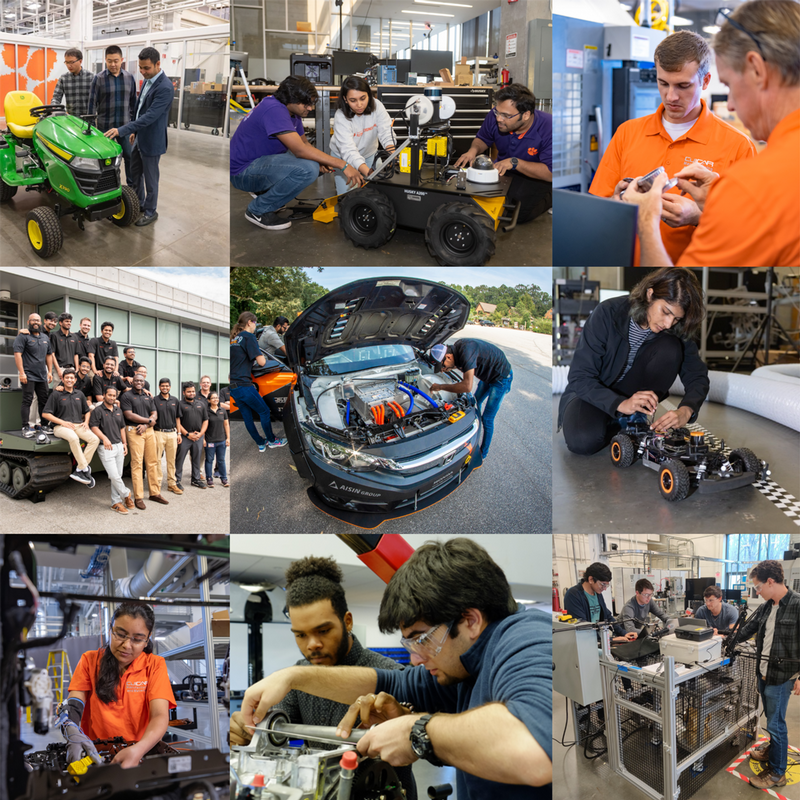
The Department of Automotive Engineering encourages undergraduates to engage with their instructors for opportunities to work on research projects in their labs and participate in Creative Inquiries. Students in their senior year can participate in a project that mirrors the Master’s level, Deep Orange. Deep Orange is a vehicle prototype program that provides an exceptional educational experience with extensive industry collaboration during the M.S. degree program in automotive engineering.
Within the graduate program, our students develop sustainable mobility solutions balancing environmental, social and economic aspects. Each project incorporates breakthrough product innovations and new processes, providing each automotive engineering student with hands-on experience in vehicle design, engineering, prototyping and production. The degree programs emphasize engineering practice and the advancement of engineering knowledge through research.
“My research experience at CU-ICAR helped to increase my interest for new automotive technologies. At CU-ICAR, I worked to find new ways to optimize the energy consumption of hybrid-electric vehicles and develop eco-driving systems that help drivers improve their ‘green’ driving skills; these efforts aimed to reduce the amount of energy consumed by vehicles. Furthermore, I had the opportunity to work in cooperation with different research groups and professors and to share experiences with exceptional women who were also pursuing their graduate studies in the automotive field.”
Jackeline Rios-TorresAutomotive Engineering, Ph.D.