MSCS Ready
Program Overview
Graduate Program
The School of Computing offers Graduate Programs at three locations across the state. If you would like to learn more about joining MSCS Ready, please contact us for more information.
 Carlos Cabrera
Senior Lecturer
cabrer3@clemson.edu
Information on Computing Courses for Clemson University Graduate Programs can be found in the Graduate Course Catalog. For answers to commonly asked questions, please view the Graduate School FAQ page.
Potential applicants interested in graduate studies at Clemson University will submit their application and all supporting material to the Office of Graduate Admissions. All material for the review process will be submitted electronically, and applicants can check the status of their application by using the online status check.
Designed to prepare those without a computer science background to begin the master's program in 1 year.
 A year-long Readiness Sequence of six instructional modules is available to prepare those without undergraduate computer science degrees to enter the Master of Computer Science program at Clemson. It is also integrated into the curriculum of our Master of Applied Computing (MAC) program. This cohort-based program accepts students for the Fall semester . The sequence is available in a hybrid format, with each class featuring an asynchronous online component and a synchronous online component. Completion of this one-year sequence prepares students to begin the master's program in the fall of the subsequent year.
Please note that these modules are not available to students already enrolled in a CIS or CPSC degree program at Clemson.
Accelerated, supportive delivery of core computer science material
- Emphasis on hands-on learning
- Six 2-credit-hour modules, two courses per semester
-
Scheduling Format
-
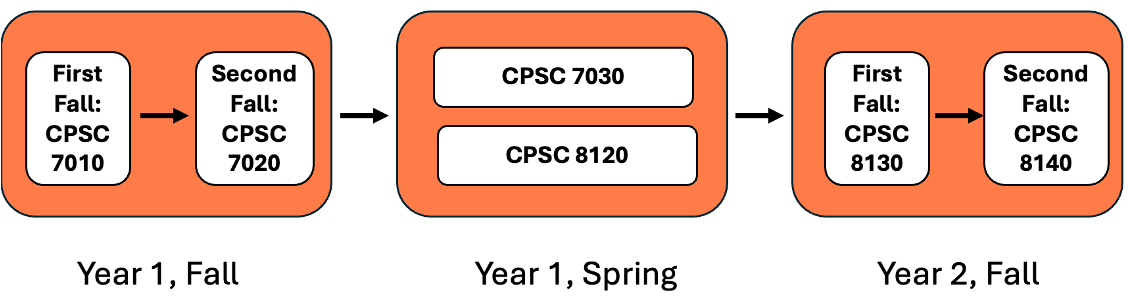
Year 1, Fall: courses are delivered in a half-semester format of 7 weeks of 4 contact hours, followed by 1 exam week
-
First Fall: CPSC 7010 - MSCS Ready, Course 1: Procedural Programming
-
Second Fall: CPSC 7020 - MSCS Ready, Course 2: Object-Oriented Programming
-
-
Year 1, Spring: courses are delivered in parallel in a full-semester format of 15 weeks of 2 contact hours, followed by 1 exam week
-
CPSC 7030 - MSCS Ready, Course 3: Discrete Structures for Computer Science
- CPSC 8120 – MSCS Ready, Course 4: Data Structures and Algorithms
-
-
Year 2, Fall: courses are delivered in a half-semester format of 7 weeks of 4 contact hours, followed by 1 exam week
-
First Fall: CPSC 8130 - MSCS Ready, Course 5: Computer Organization*
-
Second Fall: CPSC 8140 - MSCS Ready, Course 6: Operating Systems**
-
Students should apply to the MS CPSC program via the streamlined application process at the beginning of Year 2, Fall semester to be admitted to the MS CPSC program for the Year 2, Spring semester.
Students who complete the requirements of the certificate program will be awarded the MSCS Ready Certificate at the end of the Year 2, Fall semester.
* the Computer Organization course is under revision. The new title will be “Digital Foundations”
** the Operating Systems course is under revision. The new title will be “Systems and Networks”
-
-
Modules
Year 1, First Fall - CPSC 7010 - Course 1: Procedural Programming
This course focuses on software development fundamentals: the software development process and software development tools, fundamental programming concepts including memory concepts, control structures, basic data structures and the design and simple analysis of algorithms.
- Programming language and environment: C and Unix
- Credit Hours: 2
- Pre-requisites: None
Year 1, Second Fall - CPSC 7020 - Course 2: Object-Oriented Programming
This course focuses on object-oriented programming: classes and objects, information hiding and encapsulation, inheritance, and polymorphism. Continued emphasis on problem-solving and program development techniques for typical numerical, nonnumerical, and data processing problems. Introduces basic data structures, use of recursion, and file i/o, simple searching and sorting.
- Programming language and environment: C and C++; Unix/Linux
- Credit Hours: 2
- Pre-requisite: CPSC 7010 (Procedural programming) or equivalent
Year 1, Spring - CPSC 7030 - Course 3: Discrete Structures for Computer Science
This course introduces ideas and techniques from discrete structures that are widely used in the computing sciences. Topics include finite state machines; regular expressions; functions, relations and sets; symbolic logic; proof techniques; counting arguments (sum and product rules, inclusion-exclusion principle; arithmetic/geometric progressions); pigeonhole principle; computation of combinations and permutations; the computer as a state machine.
- Programming language and environment: N/A
- Credit Hours: 2
- Pre-requisite: A college-level mathematics course
Year 1, Spring - CPSC 8120 - Course 4: Algorithms and Data Structures
This course addresses the study of data structures and algorithms fundamental to computer science; abstract data-type concepts; data structures including lists, stacks, queues, trees, hash tables and graphs; measures of program running time and time complexity; algorithm analysis and design techniques.
- Programming language and environment: C and C++; Unix/Linux
- Credit Hours: 2
- Pre-requisites: CPSC 7020 (Object-oriented programming) or equivalent
- Pre- or co-req: CPSC 7030 (Discrete structures) or equivalent
Year 2, First Fall - CPSC 8130 - Course 5: Introduction to Computer Organization
This course focuses on the building blocks and structure of computers, networks and the internet. Topics include machine representation of different types of data, how instructions are represented at both the machine level and in the context of a symbolic assembler, the principles of memory management and memory hierarchy, and how computer programs organize memory. Students will study simple programs at the assembly/machine level and will be able to describe the basic properties of system performance.
- Programming language and environment: C, ARM assembly language; Unix/Linux
- Credit Hours: 2
- Pre-requisite: CPSC 7010 (Procedural programming) or equivalent
- Note: This course is under revision. The new title will be "Digital Foundations"
Year 2, Seconda Fall - CPSC 8140 - Course 6: Operating Systems
This course focuses on management techniques for the control of computer hardware resources. Topics include interrupt processing, primitive-level characteristics of hardware and the management of memory, processors, devices, and data. Students who complete this course will be able to describe the basic components of a computer operating system, discuss the impact of the process-scheduling algorithm used by an operating system, use synchronization services provided by an operating system to implement a multithreaded application program and discuss the issues involved in virtual memory support in a modern computer system.
- Programming language and environment: C, C++; Unix/Linux
- Credit Hours: 2
- Pre-requisites: CPSC 8120 (Data structures and Algorithms) or equivalent
- Pre- or co-req: CPSC 8130 (Computer organization) or equivalent
- Note: This course is under revision. The new title will be "Systems and Networks"
