Skip to content

Clemson University Forest

Strategic Plan

Introduction

The Clemson University Forest (the Forest) was established through the Clemson Community Conservation Project, initiated by Dr. George H. Aull and funded by New Deal programs. Nearly 30,000 acres of depleted farmland were acquired and restored through conservation efforts, including tree planting, erosion control and the construction of Lake Issaqueena. Clemson College began management in 1939, formally acquiring the land in 1954 with support from state and federal leaders. Silvicultural practices were introduced to enhance timber production, wildlife habitat and water quality. In the late 1950s, the creation of Lake Hartwell reduced the Forest's size, but today the portion near campus spans 19,200 acres dedicated to conservation, education, research and Clemson University's land-grant mission.

This strategic plan directly supports Clemson Elevate's pillars of the Number 1 Student Experience, Research Ascension, and Transforming Lives while upholding its land-grant mission and achieving Thomas Green Clemson's vision of "a high seminary of learning" to develop the "material resources of the state". By elevating the Forest as a cornerstone of experiential learning, the plan will provide students with unparalleled opportunities for hands-on research and fieldwork, fostering interdisciplinary education in environmental science, sustainability and land management. Additionally, it will enhance the University's research capabilities by offering a well-managed, accessible and data-rich environment for faculty and students across multiple disciplines. Finally, by reinforcing the Forest's role in community engagement and outreach, the plan will advance the University's commitment to transforming lives through education, responsible resource management and sustainable development practices.

Purpose of Strategic Plan

Through this strategic plan, the University seeks to transform the Forest, fully integrated as a strategic asset in support of Clemson's land-grant mission, into a self-sustaining resource that serves as a model for responsible land stewardship, interdisciplinary collaboration and experiential learning. The plan will provide a structured roadmap to enhance governance, secure long-term funding and balance competing interests, including research, education, recreation and conservation. By clearly defining its purpose, establishing a sustainable financial model, and implementing a structured management framework, the Forest will not only support academic excellence but also strengthen relationships with external stakeholders, including state and federal agencies, landowners and the surrounding communities. Successful implementation will protect the Forest's ecological integrity, enhance its value as an educational and research resource and solidify its role as a key contributor to Clemson University's strategic objectives.

Mission, Vision, Principles, Key Stakeholders

Our mission and vision emphasize the unique, enduring and irreplaceable nature of the Forest and Clemson’s commitment to increasing its value to all stakeholders while prioritizing its use for University needs.

Mission

The Clemson University Forest is irreplaceable, and its mission is to serve as an educational, environmental, scientific and social asset in perpetuity.

Vision

The Forest will exemplify sustainable resource management, education and innovation, embodying the University's commitment to ecological stewardship and serving the public good through scientific land management.

Guiding Principles

The principles below guide our interactions with stakeholders and the decisions the University makes with respect to programming, research, teaching and other activities in the Forest.

  1. STEWARDSHIP -
    Manage the Forest with care and responsibility, upholding the principles of the Bankhead-Jones Act; maintain the Forest as a resource for education, research, conservation and outreach; and balance the needs of students, faculty, community, University growth and long-term sustainability.
  2. INTEGRITY -
    Build trust through ethical decision-making, prioritizing the Forest’s legacy and acknowledging stakeholders.
  3. COLLABORATION -
    Foster intentional collaborations with the campus, surrounding communities and other stakeholders, working with them toward shared goals.
  4. SUSTAINABILITY -
    Adopt practices that ensure the Forest remains a thriving ecosystem and educational resource for future generations.
  5. SCHOLARSHIP -
    Maintain the Forest as a tangible asset for a high seminary of learning.

Key Stakeholders

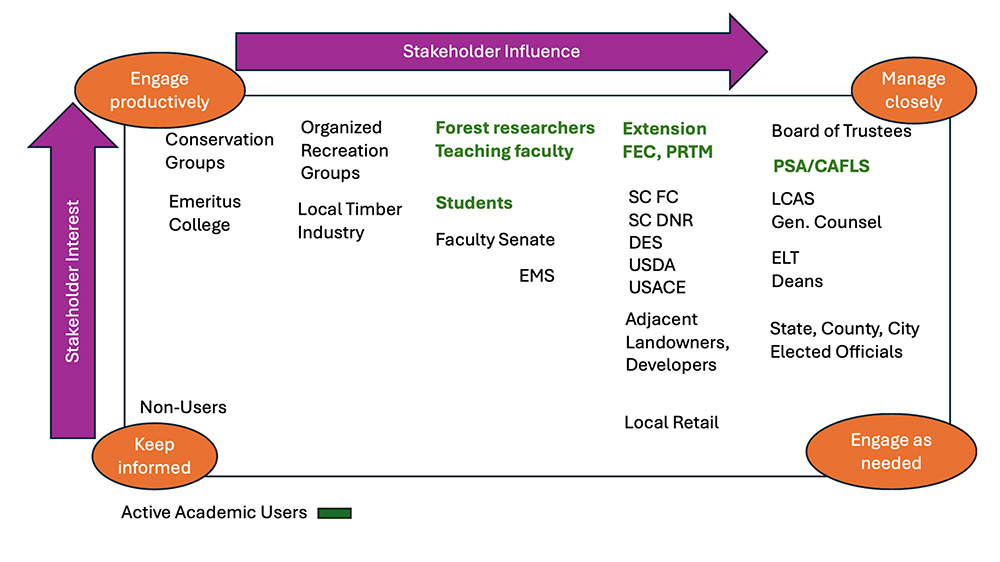
The Forest has a diverse set of key stakeholders, each with unique and sometimes competing needs, wants, and expectations (see Appendix A for a stakeholder map). This strategic plan aims to balance the needs of Clemson University and the key stakeholders while reinforcing all stakeholders’ understanding of the University’s responsibilities in managing and decision-making for the Forest.

Goals

Goal 1: Community Engagement and Student Experience

We will foster stronger connections with on and off-campus communities through education, outreach and stakeholder collaboration. The Clemson University Forest will be a model for productive interactions with the network of campus and off-campus users, volunteers and staff.

Objective 1.1: Improve Public Access and Student Experience - Create a welcoming environment for students, faculty and other visitors.

  • Create a field station and visitor center to serve as a hub for education and outreach.
  • Install professional signage at trailheads and project locations to improve navigation and awareness.
  • Improve maps and information available on navigation apps and the website for better visitor access.
  • Add video displays in the Forestry and Environmental Conservation Building, Nieri Family Alumni and Visitors Center, and Hendrix Student Center to showcase Forest initiatives.
  • Install bathroom facilities at two main trailheads to improve visitor convenience.
  • Expand student internship program.

Objective 1.2: Strengthen Community Collaborations and Public Engagement - Build productive relationships with community stakeholders and expand opportunities for education, collaboration and volunteerism.

  • Build strong relationships with user groups and coordinate volunteer activities and training.
  • Collaborate with user groups to establish a "Friends of the Forest" group for fundraising and projects.
  • Develop a formal advisory council for channeling community input on Forest-related decisions
  • Work with stakeholders to garner support for Forest initiatives.
  • Strengthen relationships with local schools, businesses and government entities to expand outreach efforts.
  • Host community events and guided tours to connect the public with the Forest's mission.

Objective 1.3: Expand Education and Outreach Initiatives - Increase educational programs, advisory mechanisms and outreach efforts.

  • Expand public education initiatives focused on conservation, sustainability and forest management.
  • Enhance online and in-person outreach efforts to share the Forest's mission and activities.
  • Create a staff culture that is welcoming to diverse perspectives of all visitors.
  • Develop a "ranger" internship program to provide a Clemson presence throughout the Forest.
  • Serve as an asset for Clemson's Cooperative Extension Service.

A goal focused on community engagement and student experience will transform the Forest into a dynamic hub for education, outreach and collaboration. By strengthening connections with students, faculty and community stakeholders, the Forest will serve as a model for sustainable land use and public engagement. These efforts will enhance experiential learning, expand volunteerism and stewardship, and deepen awareness of the Forest's role in conservation and research—ultimately fostering a stronger, more connected Clemson community.

Potential Metrics

  • Number of community events, workshops, volunteer, and Extension programs held annually
  • Growth in the number of engaged user groups and community participants
  • Tangible evidence of engagement such as volunteer work projects
  • Stakeholder satisfaction and awareness levels measured through surveys, social media participation or interviews
  • Contributions from fundraising efforts supporting conservation and research initiatives

Goal 2: Grow Research and Scholarship

We will expand research and academic opportunities within the Forest - an accessible, multidisciplinary resource with diverse study conditions and historic databases - to advance knowledge in conservation and land management, building on its past research output of nearly 500 published studies through cross- disciplinary collaboration and enhanced infrastructure.

Objective 2.1: Enhance Research - Expand collaborations with University departments, external research institutions and funding organizations to enhance research opportunities and secure funding for faculty and student-led projects.

  • Better support engagement of faculty across the University in forest research initiatives.
  • Determine how to elevate the Forest in the overall University priority lists (academic, research, state funding, Development, etc.).
  • Strengthen collaboration with University departments and external research institutions to foster collaborative research projects.
  • Secure funding for research initiatives, faculty positions and student scholarships to expand research opportunities.

Objective 2.2: Research Expansion and Knowledge Dissemination - Improve the organization, accessibility and utilization of the Forest’s data resources, ensuring that researchers across disciplines can effectively use information.

  • Develop a research management system to support interdisciplinary projects and track progress.
  • Build a data management system with controlled access
  • Enhance the research impact of the Forest by fostering publication of findings and dissemination of management techniques to landowners and other stakeholders. Establish comprehensive access to completed research.
  • Develop educational resources and workshops for landowners, policymakers and community members to apply research findings in conservation and land management.

Objective 2.3: Conservation and Sustainability Leadership - Develop innovative conservation strategies. Facilitate regional conservation efforts to support landowners, non-governmental organizations and policymakers. Conduct and disseminate research on biodiversity, climate resilience, and sustainable forestry practices.

  • Expand collaborations with local, state and federal conservation agencies and organizations to enhance preservation efforts.
  • Conduct and disseminate research on biodiversity, climate resilience and sustainable forestry practices.
  • Promote conservation management best practices within the Forest and share findings with land managers and policymakers.
  • Provide technical support, such as mapping and field assessments to regional conservation partners.
  • Involve faculty expertise from relevant departments in management of the resource, in fields such as Forestry, Recreation, Engineering, Biology, Business and related fields
  • Maintain relevant certifications, external audits, compliance with environmental regulations and other reviews.

A goal focused on enhancing research and scholarship will position the Clemson University Forest as a premier, multidisciplinary living laboratory that advances knowledge in conservation, sustainability and land management. Increased research activity and scholarly publications will elevate the Forest’s reputation as a leading center for land management, conservation and recreation research. Enhanced student engagement through hands-on learning will contribute to academic excellence and workforce development, while expanded collaboration with faculty, agencies and policymakers will drive innovation and real-world impact. Research conducted in the Forest will support the health, productivity and economic value of South Carolina’s forested lands, reinforcing the Forest’s role as a model for sustainable management. These outcomes will attract greater recognition, funding and faculty interest— strengthening Clemson’s research community and deepening connections between the University, the Forest and its many stakeholders. Improved ecological health and increased access will also support regional growth of nature-based tourism and broaden public awareness of conservation practices.

Potential Metrics

  • Number of new research projects and scholarly publications related to the Forest
  • Number of teaching/classes and Extension programs held in the Forest
  • Student participation rates in experiential learning opportunities within the Forest
  • Amount of research funding secured
  • External recognition or rankings as a leading center for forest-related research
Goal 3: Be the Change

We will be the model for organizational changes needed to exemplify excellence in land management, operations, academic engagement and environmental stewardship.

Objective 3.1: Establish the Clemson University Forest as a Model for Sustainable Land Management - Position the Forest as an exemplar of University Forests by developing best practices in conservation, forestry and long-term asset stewardship.

  • Develop the Forest as a leading example of sustainable land management for University forests.
  • Implement best practices in recreation resource management, sustainable forestry and conservation to balance ecological health with University needs.
  • Use expertise to ensure flexibility to meet University expansion needs within the context of land management, conservation and curricular goals, aligning zoning with the Long-Range Facilities Plan to protect conservation value.
  • Develop a unified vision for the Forest as a continuous, conserved land area adjacent to campus, buffered from development, and ecologically connected to other protected lands.

Objective 3.2: Strengthen Governance, Decision-Making and Strategic Direction - Enhance governance structures, leadership authority and strategic alignment to support sustainable forest management and long-term planning.

  • Transform the Forest into a global leader for management of University lands
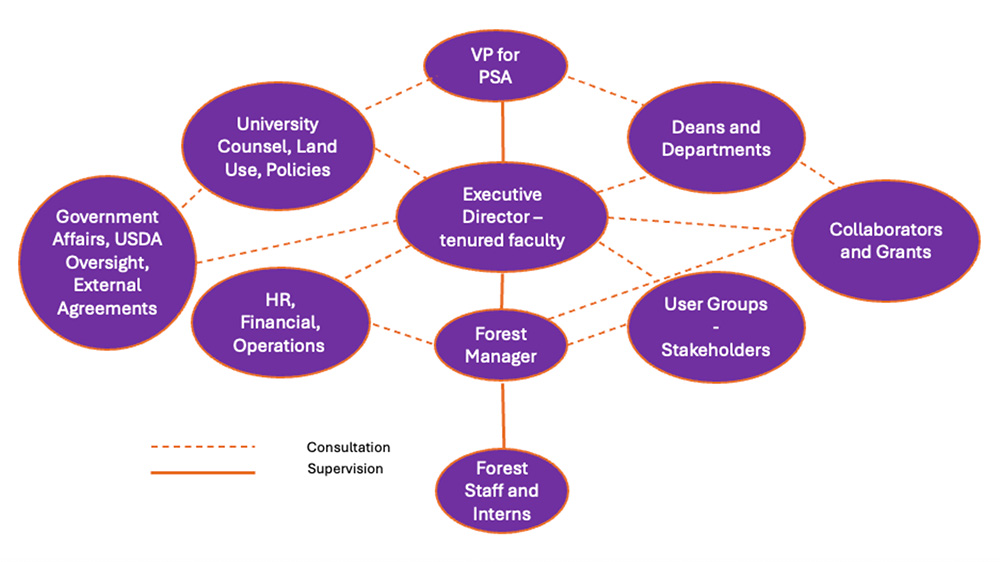
  • Transition to a governance structure and decision-making processes with formalized roles, responsibilities, accountabilities and authorities within the Strategic Plan, Forest Management Plan, Recreation Plan, and University framework
  • Improve community understanding and trust in governance
  • Clarify and adhere to roles and responsibilities for relationships with and accountability to intersecting internal and external entities
  • Use data-driven approaches for continuous improvement, tracking progress and maintaining accountability in forest management practices.

Objective 3.3: Engage the University and Public in Stewardship and Advocacy - Increase leadership in environmental stewardship through engagement, education and public outreach that reinforces the Forest’s value and mission.

  • Engage faculty and students in hands-on conservation projects that align with the Forest’s mission.
  • Showcase sustainable land management strategies through public engagement, outreach initiatives and advocacy efforts.
  • Determine how to capitalize on the Forest’s unique value to drive funding opportunities and prioritization, supported by a strong public relations strategy.
  • Demonstrate leadership in environmental stewardship through transparent actions that inspire and educate the broader community.

A goal focused on Being the Change will drive measurable improvements in Forest health and sustainability, demonstrating a commitment to responsible stewardship. By fostering a culture of individual responsibility, open communication and continuous learning, the Forest will build trust and credibility with stakeholders. Its success will serve as a replicable model for sustainable management of University lands, inspiring others to adopt best practices. Increased knowledge, awareness and engagement—both within the University community and among external constituents—will strengthen support for long-term conservation efforts. Through these initiatives, the Forest will lead by example, setting a standard for innovation and excellence in sustainability.

Potential Metrics

  • Measurable improvements in forest health indicators (e.g., biodiversity, soil quality, reforestation rates)
  • Number of external organizations or regions adopting Clemson’s sustainable management practices
  • Measurable ecosystem services to surrounding communities (e.g., clean water, air, recreation)
  • Stakeholder trust and credibility ratings, assessed through surveys or feedback
  • Internal staff training and development participation in sustainability and best practices

Goal 4: Build Sustainable Financial Support

We will establish a diversified and sustainable financial model to support the Forest’s long-term stability and growth.

Objective 4.1: Secure Sustainable Funding for Research and Conservation - Develop and maintain diverse, long-term funding sources to support research, conservation and operational initiatives within the Forest.

  • Use expertise to identify and secure sustainable funding sources that align with the Forest’s research and conservation goals.
  • Pursue donations and surplus of high-quality forest management equipment and services from industry, government collaborators.
  • Work with conservation organizations and the private sector to secure financial support and strategic partnerships and alliances.
  • Explore alternative funding models, such as developing the Forest into a Research and Education Center (REC), innovation campus, or other structured entity to enhance funding opportunities.

Objective 4.2: Strengthen Community Advocacy - Foster relationships with key stakeholders to secure long-term support for the Forest and its initiatives.

  • Work with conservation organizations and the private sector to build financial collaborations.
  • Collaborate with stakeholders to build a “Friends of the Forest” program to support fundraising and community-led conservation projects.
  • Engage with state and federal governments and agencies to pursue funding that aligns with conservation and research priorities.
  • Use a formal advisory council (Objective 1.2) to facilitate structured community input and advocacy efforts related to funding.

Objective 4.3: Develop a Sustainable Funding and Resource Strategy - Identify, secure and implement diverse revenue streams and resources to support the financial sustainability of the Forest.

  • Utilize internal and external expertise in development, government affairs, industry and programmatic grants to identify and secure sustainable funding sources for forest management, education and research activities.
  • Implement revenue-generating initiatives such as event fees, sustainable forestry practices and potential donor-based programs.
  • Advocate for state and federal funding to ensure long-term financial sustainability.
  • Assess and evaluate opportunities to establish the Forest as an innovation campus, research and education center (REC), or other sustainable institutional models.

A goal focused on building sustainable financial support will establish a stable, diversified funding base that ensures long-term viability. Financial resource growth will support infrastructure improvements, strategic land management and expanded staffing to enhance research, teaching and community engagement. Stronger collaborations will provide ongoing financial and operational support, fostering innovation and growth. Sustainable funding will also enable investments that will ensure a secure and efficient environment. Ultimately, these efforts will position the Forest for long-term success as a leading center for conservation, education and research.

Potential Metrics

  • Diversification of revenue streams, reducing dependence on timber markets
  • Total financial resources secured for infrastructure, staffing and research
  • Amount of funds raised for the Forest Endowment and key project initiatives

Goal 5: Build and Execute an Effective Marketing and Communication Strategy

We will implement a strategic communication plan that enhances visibility, understanding and support for the Forest.

Objective 5.1: Develop and Implement a Strategic Communication Plan – Design a comprehensive communication strategy that effectively conveys the Forest's mission, goals and impact to internal and external stakeholders.

  • Build a strong communication plan that aligns with the Forest's strategic goals and ensures stakeholder buy-in.
  • Collaborate with University marketing teams and public relations professionals to enhance outreach efforts.
  • Develop clear, mission-aligned messaging supported by scholarly work and accurate statistics to educate various audiences.
  • Establish consistent communication with stakeholders through reports, presentations and regular updates.

Objective 5.2: Enhance Visibility and Public Engagement – Increase public awareness and support for the Forest through accessible and engaging communication channels.

  • Create centralized platforms (such as website, social media, annual reports) for information dissemination.
  • Utilize storytelling and visual content to highlight the Forest's research, conservation efforts and community impact.
  • Improve visitor experience through professional signage at trails, a visitor center and enhanced on-site informational displays.
  • Ensure staff and vehicles are recognizable to reinforce the Forest's presence and engagement.

Objective 5.3: Strengthen Relationships with Key Stakeholders - Foster strong connections with government agencies, donors, and institutional leaders to elevate the Forest's profile and funding opportunities.

  • Work with state and federal government agencies to ensure productive collaboration and long- term support.
  • Elevate the Forest on the priority list of development officers and initiatives, such as university- level capital campaigns to attract donor engagement.
  • Develop a comprehensive donor and development plan to secure funding and long-term relationships.
  • Productively engage the outdoor recreation community through organized volunteer efforts, trainings, social media and events
  • Regularly engage the faculty in discussion about the Forest's role in supporting education and research, and quality of life, such as through the Faculty Senate, Emeritus College and related entities

A goal focused on building and executing an effective marketing and communication strategy will ensure a well-informed public and University community, increased awareness of the Forest and its various functions and uses. Greater visibility will strengthen engagement with donors, policymakers and research partners, fostering new opportunities for collaboration and support. A clear and compelling communication strategy will enhance the Forest's ability to advocate for resources and policy initiatives that sustain its mission. By effectively showcasing its impact on conservation, education and research, the Forest will solidify its role as a vital asset to the University and broader community.

Potential Metrics

  • Public and University community awareness levels, measured through surveys or engagement metrics
  • Growth in media mentions, website traffic and social media engagement related to the Forest
  • Number of mentions in Extension publications
  • Number of new relationships formed with donors, policymakers and research organizations
  • Number and size of new classes, research projects, and community events in the Forest
  • Increase in advocacy success, such as policy support or additional resource allocations

Risk Considerations

  • Safety and liability issues in the Forest, especially related to recreational use
  • Risk of fire, disease and other forest and wildlife problems that could influence our neighbors
  • Public perception of the Forest as a publicly owned and freely accessible resource
  • Loss of control over its future as an academic resource
  • External financial perturbations, such as forest products markets, markets for non-timber forest products
  • Climate extremes and invasive species changing the character and function of the Forest
  • Excessive environmental regulations or regulations over cultural resources that limit ability to manage for the mission
  • Urbanization on Forest boundaries, resulting in unregulated recreational access and limits on forest management
  • Political changes influencing relationships with public agencies at the state and federal levels

Key Performance Indicators

To measure progress and ensure accountability in advancing the vision for the Clemson University Forest, the following Key Performance Indicators (KPIs) have been identified. These indicators provide clear, measurable targets that align with the strategic priorities of sustainability, education, research, and conservation.

  1. Financial Sustainability
    • Achieve self-sufficiency with an annual operating budget of at least $3 million (in today’s dollars) within 10 years, supported by multiple revenue streams.
    • Data Source: CAFLS Budget, revenue sources
  2. Revenue Diversification
    • Expand the number of significant revenue sources from the current 3 to 6 within 5 years, establishing a multi-variant pricing model for long-term sustainability.
    • Data Source: CAFLS Budget, revenue sources
  3. Community and Public Engagement
    • Increase opportunities for interactions with the public by 50%, raising visitation levels from 60,000 to 90,000 annually within 5 years.
    • Data Source: Cell phone data from Placer
  4. Student Access
    1. Develop a direct portal for students to access the Forest by foot or bike from campus within 10 years, enhancing experiential learning opportunities.
  5. Faculty Engagement
    • Increase the percentage of faculty using the Forest for research (currently 19%) and teaching (currently 17.5%) to 30% within 10 years.
    • Data Source: 2022 Faculty Senate survey and report
  6. Conservation and Land Stewardship
    • Reassign the USDA Reverter Clause from 1,000 acres of developable land to 1,000 acres of high- value land prioritized for conservation, research, and teaching.
    • Data Source: Forest Advisory Committee, GIS analysis for USDA

Conclusion

This inaugural stand-alone strategic plan recognizes the Clemson University Forest as a unique University asset for research, education and outreach and the importance of its long-term sustainability. It sets a clear vision and direction, balancing the needs and interests of both the University and external stakeholders while aligning with the institution's current and future priorities. The plan provides a high- level framework that guides the development of a tactical forest management plan, ensuring compliance with land use restrictions, state and federal laws, legal agreements and policies set by the University and its Board of Trustees. Additionally, it formalizes the Forest's role within Clemson Elevate, positioning it as a model for responsible land stewardship and interdisciplinary collaboration.

Through the execution of this plan, the University aims to secure and diversify financial resources and establish a clear governance structure that supports both the Forest and the institution over the long term. The plan also seeks to enhance awareness of the Forest's value, increasing its use as a vital resource for teaching, research and community engagement. By reinforcing the Forest's role in fulfilling Clemson's land-grant mission, this strategic plan ensures its alignment with Clemson Elevate's overarching strategic pillars of student experience, research ascension and transforming lives. Furthermore, this plan is designed to complement other strategic plans, such as those for Historic Properties, the College of Agriculture, Forestry and Life Sciences (CAFLS) and relevant departments (e.g. Forestry) and Research and Education Centers, ensuring a coordinated and sustainable approach to institutional growth and land management.

For more information about the Clemson University Forest, contact Dr. Robert Baldwin, Executive Director, Clemson University Forest, baldwi6@clemson.edu.

This plan will be reviewed annually as part of the Clemson University Forest's annual operational and budget planning and will be updated as needed.

Appendix

Appendix A -

Key stakeholders, their influence and engagement, and management strategies

 stakeholder map

The stakeholder map represents a matrix of current interest and influence, allowing managers to focus a strategy of engagement on each group. Through time, the position on the matrix of stakeholders can change depending on the success of each strategy, direct involvement by stakeholders, funding for initiatives, etc. Managers should closely track the results of engagement to ensure desired outcomes.

Appendix B - Glossary of Terms and Acronyms

Terms

  • Bankhead-Jones Act - New Deal legislation to purchase marginal and sub-marginal lands from farmers and restore the land to productivity.
  • Biodiversity - The variety of life in a particular habitat, ecosystem or geographic area.
  • Community - Users of the forest who are students, faculty, and staff at Clemson or live in surrounding towns and cities.
  • Ecosystem Services - Services that an area of land and water provides to society, such as clean water and air, carbon storage, crop pollination, or recreation.
  • Extension - Clemson Cooperative Extension Service (CAFLS)
  • Forest Health - Overall condition of a forest, including its diversity, function, and vitality.
  • Forest Management - Actions taken to improve the economic and environmental quality of a forest.
  • Invasive Species - Non-native organisms that, when introduced to a new area, proliferate and
  • cause harm to that ecosystem.
  • Recreation - Activity done for enjoyment, refreshing strength and spirits after work.
  • Resilience - Ability of an ecosystem or place to return to its former structure and function following disturbance.
  • Stakeholder - Those with an interest in and concern for the forest as a resource.
  • Stewardship - The act of caring for land, water, and the resources contained therein.
  • Sustainable - Managing resources for their uses, while enhancing their value for future generations.

Acronyms

  • ELT - Executive Leadership Team, Clemson University
  • EMS - Emergency Management Services (County, State, City, University)
  • FEC - Department of Forestry and Environmental Conservation, Clemson University
  • LCAS - Land and Capital Asset Stewardship, Clemson University
  • PRTM - Department of Parks, Recreation, and Tourism Management, Clemson University
  • PSA - Public Services and Agriculture, Clemson University
  • SC DES - South Carolina Department of Environmental Services
  • SC DNR - South Carolina Department of Natural Resources
  • SC FC - South Carolina Forestry Commission
  • USACE - US Army Corps of Engineers
  • USDA - United States Department of Agriculture

Appendix C - Organization Structure

organizational structure