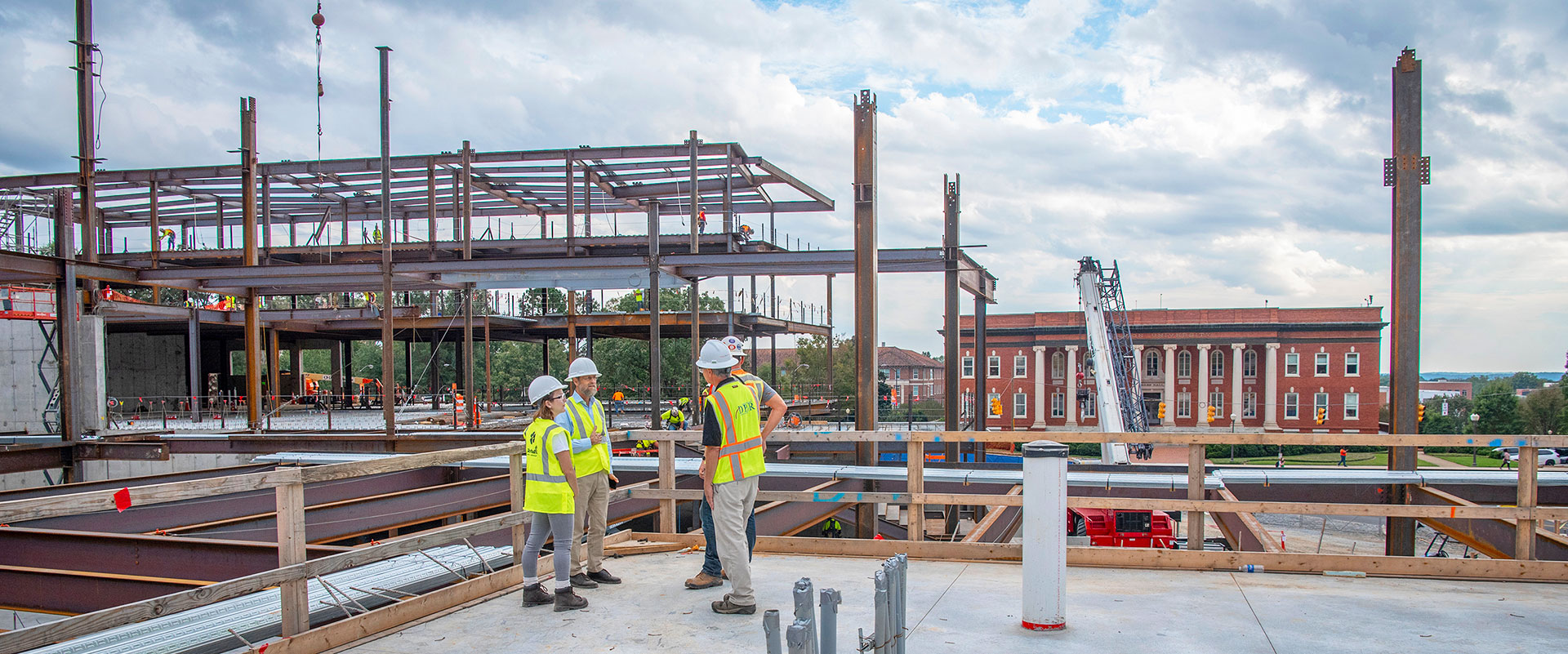
Addressing Critical Systems
Research in Clemson University’s Glenn Department of Civil Engineering brings together faculty, students, and industry partners to address some of today’s most pressing infrastructure and environmental challenges. Located primarily in Lowry Hall, the department houses extensive undergraduate and graduate laboratories, research facilities, and collaborative workspaces. Additional specialized facilities extend beyond the main campus, including the Wind Load Test Facility, which houses one of the largest boundary-layer wind tunnels in the nation. Supported by more than $5.4 million in annual research expenditures, Clemson civil engineering researchers are advancing solutions that improve the safety, sustainability, and performance of the built environment.
Collaborative Research Across Disciplines
Faculty and graduate researchers work across the six core areas of civil engineering, developing new materials, analytical tools, and technologies that strengthen infrastructure and improve system performance. From investigating soil liquefaction, earthquake ground response, and foundation systems to advancing sustainable construction materials and infrastructure restoration, the department’s research integrates experimental, computational, and field-based approaches to address the urgent need to modernize aging infrastructure while supporting resilient, efficient construction practices.
The department’s interdisciplinary research also spans risk engineering, structural systems, mobility networks, and environmental fluid mechanics. Researchers develop advanced models to better understand risk across natural hazards, explore innovative structural solutions for the built environment and improve transportation systems that support the movement of people and goods.
-
Construction Engineering and Management
The program fills the need for construction managers who have the ability to respond to the changing environments within the industry: sustainable construction, restoration and system analysis and modeling. The faculty includes world-class experts in creating cutting-edge theories, methods and tools, and devising workflows for greater efficiency and better collaboration during construction projects.
Construction Engineering ResearchPrimary Contact
Kalyan Piratla
Associate Professor
kpiratl@clemson.edu -
Construction Materials
The much-needed reconstruction and replacement of an aging infrastructure places increased emphasis on developing new and/or improved construction materials. In addition to construction materials courses, students can select courses in other civil engineering areas; other branches of engineering such as ceramic, chemical, mechanical and textile; and forestry. The faculty are involved in cutting-edge research in construction materials, including materials for sustainable infrastructure.
Construction Materials ResearchPrimary Contact
Amir Poursaee
Associate Professor
amire@clemson.edu -
Geotechnical Engineering
The primary emphasis is on the investigation of soil liquefaction, earthquake ground response, braced excavation systems, pile foundations, and soil dynamics. Geotechnical Engineering research in the Department of Civil Engineering at Clemson University includes both experimental and analytical investigations. Faculty are involved in computational, analytical as well as experimental and field studies.
Geotechnical Engineering ResearchPrimary Contact
Nadarajah Ravichandran
Associate Professor
nravic@clemson.edu -
Risk Engineering
Risk Engineering and System Analytics is an emerging field with rapid growth and is interdisciplinary in nature. It draws on understanding structural engineering, natural catastrophe modeling, human error, data, business risk, and supply chain to effectively model and manage risk profiles. This area of specialization provides a foundation for those individuals intending to pursue careers as risk managers, risk engineers, underwriters, researchers, or data scientists.
Risk Engineering ResearchPrimary Contact
Abdul Khan
Professor
abdkhan@clemson.edu -
Structural Engineering
This field deals predominantly with structural systems in the built environment. It has become increasingly specialized, and advanced study is nearly always required for more interesting and challenging employment opportunities and advancement. The emphasis of both the teaching and research activities within the Structural Engineering Program provides a good foundation for those individuals intending to pursue careers in design practice, research, or academics.
Structural Engineering ResearchPrimary Contact
Brandon Ross
Associate Professor
bross2@clemson.edu -
Transportation Systems
Mobility systems are essential for the efficient movement of people and goods. Air, land and marine transportation systems play a vital role in ensuring a strong economy and a good quality of life. The transportation graduate program at Clemson focuses on the planning, design, operation and maintenance of transportation systems.
Transportation Systems ResearchPrimary Contact
Mashrur Chowdhury
Professor
mac@clemson.edu -
Water Resources Engineering
The Fluid Mechanics and Water Resources program emphasizes the flow of common, natural fluids - water and air - the forces they create, and the movement of materials - suspended or dissolved - within those fluids. Faculty conduct research in environmental fluid mechanics, sediment transport and scour, turbulent jets, plumes, contaminated sediments, coastal engineering, dredging-related operations, raindrop physics, and others.
Water Resources ResearchPrimary Contact
Abdul Khan
Professor
abdkhan@clemson.edu
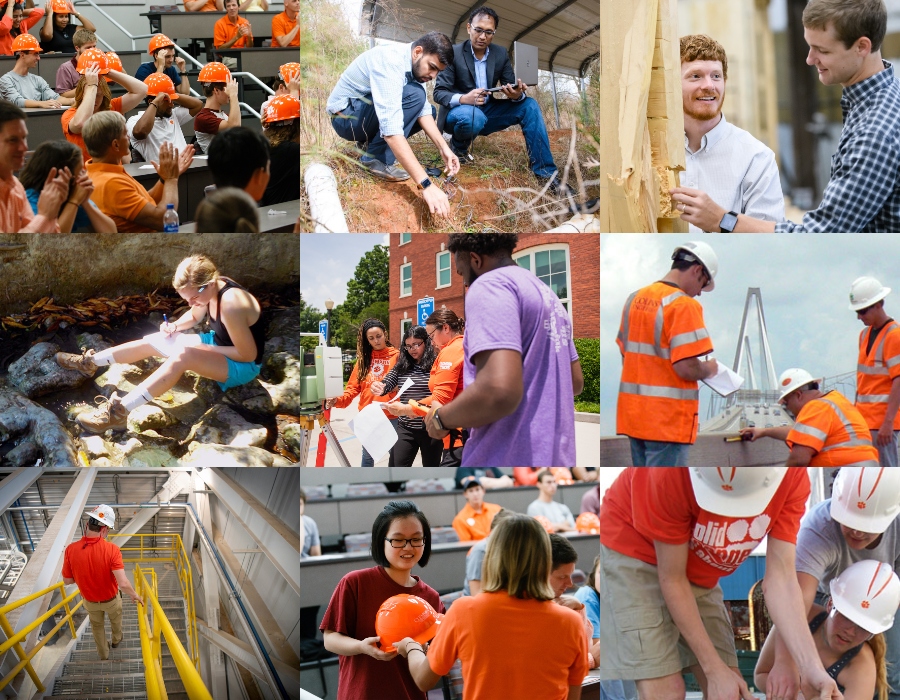
The Glenn Department of Civil Engineering encourages undergraduates to participate in department research or Creative Inquiry projects. About 25 percent of our students are involved in research throughout the year and work closely with faculty, peers, and industry on hands-on research projects.
The graduate program focuses on convergent research related to global grand challenges involving infrastructure and the environment. The degree programs emphasize engineering practice and the advancement of engineering knowledge through research.
“The summer before my freshmen year at Clemson, I had the privilege to start work as an undergraduate research assistant under both Brandon Ross and Thomas Cousins. The research was interesting, but it was Dr. Ross’ and Dr. Cousins’ leadership that cemented my desire to pursue structural engineering. Since that summer, I have continued to perform research under both professors. As a result of my work, I will have a paper I authored presented during an engineering conference in Portugal next summer.”
Sam DoddStructural Engineering
An academic department within the School of Civil and Environmental Engineering and Earth Sciences
