
Online Summer Courses
Summer Session at Clemson registration opens on April 6, 2026, and the first term begins May 12.
Engineering This Summer, Your Way (Sync + Async Options)
These courses offer online and summer scheduling flexibility, providing Clemson students and students from other colleges and universities with the opportunity to take technical elective courses in Mechanical Engineering.
All course activities will be conducted online and will be available 24/7. Homework and exams will be submitted online. Weekly daytime and evening online office hours will be offered in addition to a 24-hour turnaround on email questions. There is no laboratory work associated with these courses.
Information about the courses is given below. Syllabi for previous versions of the courses are available in the Syllabus Repository. Current syllabi are available from the instructors.
All Summer Courses-
ME 2030, 2040, 2050, 2060, 2070
ME 2030 - Foundations of Thermal and Fluid Systems
Catalog Description: Introduction to control volumes, conservation laws of mass, momentum, and energy. Concepts of work and heat are introduced, including rate forms. Properties of pure substances.
Credits: 3
When: First Summer (May 12 - June 19)
Prerequisites: MATH 2060 and PHYS 2210, each with a grade of C or better.
ME 2040 - Mechanics of Materials
Course Description: Relationships between external loads on solid bodies or members and the resulting internal effects and dimension changes, including the derivation of rational formulas for stresses and deformations and the identification and use of important mechanical properties of engineering materials. Includes Honors sections.
Credits: 3
When: Second Summer (July 1 - August 4)
Prerequisites: MATH 2060 and one of ME 2010 or ME 2050, each with a grade of C or better. Preq or concurrent enrollment: MATH 2080 and MSE 2100, each with a grade of C or better.
ME 2050 - Statics for Mechanical Engineers
Catalog Description: Forces and force systems and their external effect on bodies during the condition of equilibrium. Vector techniques are employed, and the rigor of physical analysis is emphasized.
Credits: 3
When: First Summer (May 12 - June 19)
Prerequisites: Both ENGR 1080 and ENGR 1090; or ENGR 1410; or ENGR 1640, each with a grade of C or higher; and MATH 1080 and PHYS 1220, each with a grade of C or higher. Preq or concurrent enrollment: MATH 2060.
ME 2060 - Dynamics
Course Description: Principal topics include kinematics and kinetics of particles and rigid bodies of finite size. The course covers the analysis of the motion of particles and rigid bodies encountered in engineering, as well as velocity, acceleration, relative motion, work, energy, impulse, and momentum. Techniques of vector mathematics are used to solve problems.
Credits: 3
When: Second Summer (July 1 - August 4)
Prerequisites: MATH 2060 and ME 2050, each with a grade of C or higher. Preq or concurrent enrollment: MATH 2080 with a grade of C or higher.
ME 2070 - Design of Mechanical Systems
Catalog Description: Introduction to mechanical engineering design and elements of mechanical engineering systems. Open-ended problem-solving, design, and the resourceful application of mathematics, physics, and general principles from students' science courses are emphasized.
Credits: 3
When: First Summer (May 12 - June 19)
Prerequisites: Both ENGR 1080 and ENGR 1090; or ENGR 1410; or ENGR 1640, each with a grade of C or higher; and PHYS 1220 with a grade of C or higher. Preq or concurrent enrollment: ME 2000.
-
ME 3030, 3040, 3050, 3060, 3080, 3120
ME 3030 - Thermodynamics
Course Descriptions: Study of the second law and entropy. Includes applications to fixed mass systems and control volumes; vapor and gas power cycles; mixtures of gases; vapor psychrometrics; combustion and the third law. Thermochemical equilibrium.
Credits: 3
When: Second Summer (July 1 - August 4)
Prerequisites: ME 2030 with a C or better.
ME 3040 - Heat Transfer
Catalog Description: Study of steady and transient heat conduction, free and forced convection, radiation, and multi-mode heat transfer. Emphasizes analytical and numerical solutions to engineering heat transfer problems with a design orientation.
Credits: 3
When: First Summer (May 12 - June 19)
Prerequisites: MATH 2080 and ME 3080 each with a C or better. Preq or concurrent enrollment: MATH 3650 with a C or better.
ME 3050 - Modeling and Analysis of Dynamic Systems
Catalog Description: Presents techniques for developing and analyzing models of mechanical, electrical, electromechanical, fluid and thermal systems. Transient, steady-state and frequency responses are determined using analytical and numerical methods. Covers tools for stability analysis and state-space representation. Covers linear free- and forced-vibrations in single- and multi-degree-of-freedom systems with lumped-parameters representation, methods of vibration absorption and isolation.
Credits: 3
When: First Summer (May 12 - June 19)
Prerequisites: MATH 2080, MATH 3650, and one of ME 2010 or ME 2060, each with a grade of C or better. Preq or concurrent enrollment: ECE 2070 and ECE 2080.
ME 3060 - Fundamentals of Machine Design
Course Description: Introduction to failure theory and fatigue analysis. Integration of these topics with selected portions of the mechanics of materials and their application to the design and analysis of machine elements.
Credits: 3
When: Second Summer (July 1 - August 4)
Prerequisites: ME 2040 and one of ME 2070 or ME 3070, each with a C or better.
ME 3080 - Fluid Mechanics
Course Description: Behavior of fluids at rest or in motion, including the study of fluid properties. Emphasizes a rational, analytical approach from which basic principles of broad applicability to all fields of engineering are developed. Includes Honors sections.
Credits: 3
When: Second Summer (July 1 - August 4)
Prerequisites: ME 2030 and one of ME 2010 or ME 2060, each with a C or better. Preq or concurrent enrollment: MATH 2080.
ME 3120 - Manufacturing Processes and Their Application
Catalog Description: Fundamental principles associated with production processes and their application to the manufacture of products from metals, polymers, ceramics, and composites. Emphasizes the physical and quantitative aspects of processing, the selection of processes to create products, and the identification processes used to manufacture existing products.
Credits: 3
When: First Summer (May 12 - June 19)
Prerequisites: MSE 2100 with a C or better. Preq or concurrent enrollment: ME 3040, ME 3060 and ME 3330, each with a C or better.
-
ME 4010, 4020, 4030, 4230/6230, 4540/6540, 4580/6580
ME 4020 - Internship in Engineering Design
Course Description: Creative application of general engineering knowledge in solving an open-ended design problem provided by a sponsor, typically external to the University. Progress is evaluated by a faculty jury. Students present results to the jury and sponsor through written reports and oral presentations that address the University's written/oral competency goals.
Credits: 3
When: Second Summer (July 1 - August 4)
Prerequisites: ME 3030, ME 3040, ME 3050, ME 3060, ME 3080, ME 3120, ME 3330 and ME 4010, each with a grade of C or higher. Coreq: ME 4021.
ME 4030 - Control and Integration of Multidomain Dynamic Systems
Course Description: Introduction of control theory with sensor, actuator, and dynamic plant integration to develop, model, control, and analyze mathematical models of dynamics systems, including mechanical, electrical, electromechanical, hydraulic and pneumatic systems. Transient dynamics are determined using analytical and numerical methods with feedback control systems. Strong emphasis is placed on system design using computer simulation tools.
Credits: 3
When: Second Summer (July 1 - August 4)
Prerequisites: ME 3050 with a C or better.
ME 4230/6230 - Introduction to Aerodynamics
Course Descriptions: Basic theories of aerodynamics are presented for the purpose of accurately predicting the aerodynamic forces and moments that act on a vehicle in flight.
Credits: 3
When: First Summer (May 12 - June 19)
Prerequisites: ME 3080 with a C or better.
ME/ECE 4570/6570
Course Description: Introduces wind turbine systems, including wind energy potential and application to power generation. Topics include wind energy principles, wind site assessment, wind turbine components, power generation machinery control systems, connection to the electric grid, and maintenance. May also be offered as ECE 4570.
Credits: 3
When: First Summer (May 12 - June 19)
Prerequisites: ECE 2070 or ECE 3200, with a C or better.
ME 4540/6540 - Design of Machine Elements
Course Description: Design of common machine elements, including clutches, brakes, bearings, springs, and gears. Optimization techniques and numerical methods are employed as appropriate.
Credits: 3
When: Second Summer (July 1 - August 4)Prerequisites: ME 3060 with a C or better.
Prerequisites: ME 3060 with a C or better.
ME 4580/6580 - Fundamentals of Micro/Nano Fabrication
Course Description: Fundamental principles behind micro and nano manufacturing processes used in MEMS, bioMEMS and related fields. Overviews of cleanroom environments and materials used in the field. Details the physical and chemical aspects of photolithography, next-generation lithography, dry and wet etching and physical and chemical vapor deposition. Includes a lab section to reinforce knowledge acquired during lectures.
Credits: 3
When: Second Summer (July 1 - August 4)
Prerequisites: ME 3120
-
ME 8010, 8610
ME 8010 - Foundations of Fluid Mechanics
Course Description: Derivations of basic equations for multidimensional flow fields; analytical techniques for solving problems in laminar viscous flow and laminar inviscid flow; theories of similitude.
Credits: 3
When: Second Summer (July 1 - August 4)
Prerequisites: N/A
ME 8610 - Materials Selection in Engineering Design
Course Description: Advanced study of various physical, chemical and mechanical materials properties which govern the selection of materials in engineering design. Case studies of materials selection in design, including metals, ceramics, polymers and composites, are presented.
Credits: 3
When: First Summer (May 12 - June 19)
Prerequisites: N/A
-
Register for Summer Courses
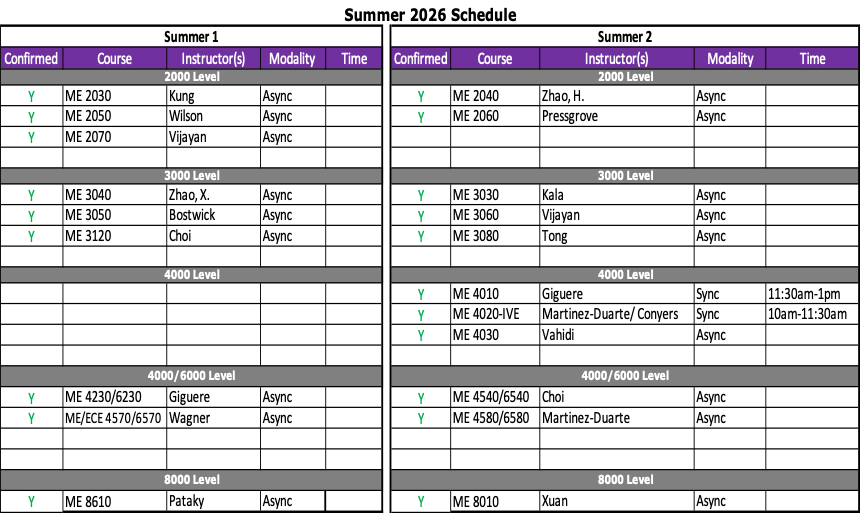
Current Clemson students will register for summer courses through iROAR.
If you are currently an undergraduate student at another institution, you may apply to attend Clemson as an undergraduate transient student.
If you are currently a graduate student at another institution or hold a bachelor's degree, you may apply to attend Clemson as a graduate transient/special student.
If you are not currently a college student at any institution, regardless of bachelor's degree status, you may apply to attend Clemson as a non-degree-seeking special student. High school students fall into this category. For undergraduate or graduate classes, the choice depends on whether to take 4000 or 6000-level courses. In most cases, you will want to apply as a graduate student.
Summer Application Steps
- Determine which courses you would like to take. Courses numbered 1000-4999 are taught at the undergraduate level. Courses numbered 6000-8999 are taught at the graduate level. Note that some courses are offered at both the 4000- and 6000-level. In that case, you should choose the course that grants you the credit you wish to receive. Keep in mind that the 6000-level course will include additional work in the form of research projects or papers.
- Apply as either a special student or transient student, undergraduate or graduate.
- Fill out the Transient/Special Student Enrollment Form. Email it along with your choice of classes so that you may receive an override to register to:
- Undergraduate (1000-4999): Portia Mitchum
- Graduate (6000 and up): Irina Kharitinova
- Once your application has been accepted, register for your courses through iROAR.
Note that courses must meet minimum enrollments; otherwise, classes may be canceled and tuition refunded in full. Application fees cannot be refunded.
-
I am a transient student. How do I take classes at Clemson?
I am a student at another university. How do I apply to take online ME courses at Clemson this summer?
To apply as a transient student, please follow the steps listed and submit the transient student application as instructed on the registrar's website.
First: Complete the Transient Student Application and pay the $40 application fee. Payment instructions are provided in the online application.
During: Check course syllabi before applying and consult your home institution about credit transfer before enrolling. Transient students may request current and upcoming summer course syllabi by contacting the ME registration coordinator.
After: Acceptance notifications are emailed to the address provided on the application. The email will contain your Clemson User ID, CUID number and temporary password, along with information on how to register for classes.How do I access my Clemson University email account?
For assistance, visit CCIT's New Students website. If you are enrolled in a course at Clemson, you must access and review your Clemson email regularly, starting no later than the first day of the course session.
How do I transfer the Clemson course credits to my home institution?
Please contact your home institution for instructions on transferring credits. Ideally, this should be done before the course begins, as a particular home institution may not grant a course the kind of credit a student expects. Typically, the home institution requests a sample syllabus. Upon completion of the course, the home institution will then want an official transcript. Information on ordering an official Clemson transcript can be found on the Student Records - Transcripts page.
I have enrolled as a transient student and need to add or drop courses - how can I get help with this process?
If you have been enrolled as a transient student and later need to add or drop courses, you may encounter problems with prerequisite or other course requirements in our registration system. Please contact the ME registration coordinator.
