Career Experience
Career Growth Pathways
⇧9%The demand for mechanical engineering (ME) continues to grow. According to the U.S. Bureau of Labor Statistics, employment of mechanical engineers is projected to grow 9% over the next few years, with approximately 18,000 openings each year.
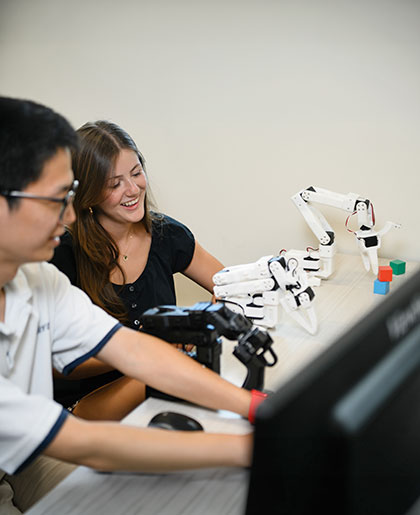 The versatility of an ME degree allows graduates to pursue careers across industries and build expertise around the technologies and challenges that interest them most. As manufacturing processes become more automated and incorporate more complex machinery, there is increased demand for engineers to design, develop, test, and maintain a variety of products and systems.
Mechanical engineers are expected not only to innovate but also to help integrate new equipment into existing systems.
Specialize Expertise
Students who choose to pursue an advanced degree can further specialize their expertise toward opportunities in research, development, and technical leadership, while also increasing their long-term earning potential.
Build Your Career Before You Graduate
Professional career development in mechanical engineering doesn’t have to wait until after graduation. At Clemson, students can take what they learn in the classroom and put it to work in a wide array of opportunities through options like the ASME Student Chapter, ME Industry Track Graduate Internship and Curricular Practical Training for F-1 Students, gaining paid engineering experience with industry partners while completing their degree.
Advanced degree holders in mechanical engineering enjoy:
- Higher starting salaries and long-term earnings projections
- Research and Development positions with innovative assignments
- Opportunity to specialize in their area of interest
Source: U.S. Bureau of Labor Statistics, Employment Projections program
Positions of our Mechanical Engineering M.S. and Ph.D. Alumni
Clemson University Mechanical Engineers graduates receive positions in leading global companies. Please review some of our alumni positions below:
- Manufacturing Equipment Engineer, TESLA
- Advanced Process Improvement Engineer, Sage
- Mechanical Engineer, Michelin, North America
- PREP Postdoctoral Associate, National Institute of Standards and Technology (NIST)
- Senior Member of Technical Staff, Sandia National Laboratories
Employment Data for International Students
The average employment rate for Clemson University Mechanical Engineering international graduate students who applied for Optional Practical Training (OPT) to receive employment in the U.S. upon graduation is 83%. Below you can review the most recent employment data for the last 4 years, Spring 2022- Fall 2025.
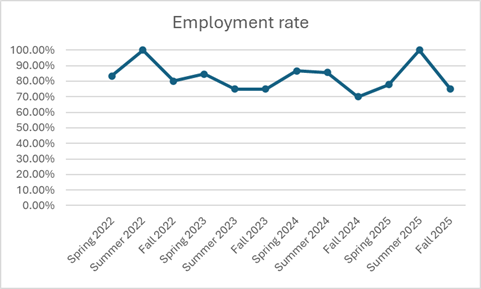
Student employment % in the U.S. (y-axis) against graduation rates by term (x-axis)
Undergraduate Advancement
The Co-op Experience
As a Mechanical Engineering Co-op student, you could help design and develop new products, improve manufacturing processes, solve quality and production challenges, support major engineering projects, or work on the mechanical systems that bring buildings and facilities to life.
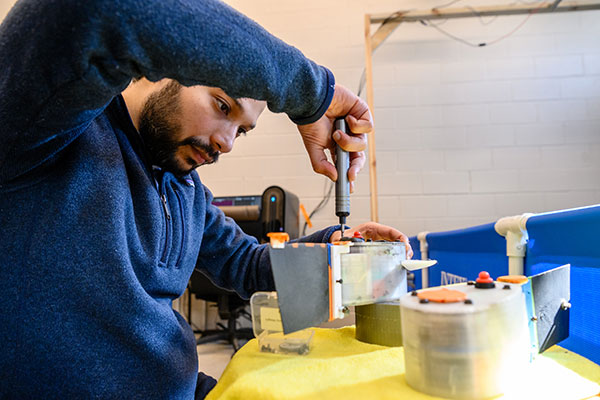 Clemson’s employer partners offer opportunities in areas such as product development, manufacturing, operations, project management, process improvement, quality, and MEP design, across industries including automotive, aerospace, medical devices, advanced materials, building systems, construction, defense, power and energy, and consumer products. Whatever area of mechanical engineering interests you, Co-op offers a chance to experience it firsthand while getting paid and building your career.
No prior professional or internship experience is required. Still, companies do prefer that students have had responsibilities and are involved in activities. Hence, some ideas are to obtain a position working on campus (UPIC), participate in a Creative Inquiry (CI), work a part-time job, join a major or engineering-specific club or other student organization, volunteer, and/or participate in intramural or club sports. These activities provide talking points for company representatives to discuss with students during interviews and help fill out a one-page resume.
Career Center | Program ME FAQ | Co-opWhen the time comes, you do not have to find your own co-op. The semester before you start your rotations, you enroll in COOP 1000, which will walk you through building your resume, researching companies, and practicing interviewing skills.
Longer work experience: Unlike a typical summer internship (8–12 weeks), the co-op experience spans multiple semesters with the same employer.
- Most co-op positions are paid, with students earning a competitive salary while gaining professional experience.
Alternate semesters: Many co-op programs have students alternate between taking classes and working full-time to complete one year of work experience prior to graduation. For example:
- Fall: Classes
- Spring: Full-time co-op job
- Summer: Classes or another co-op term
- Repeat for 3 work rotations
First Step
Enrollment in COOP 1000 (0-credit placement course)
Students meet 1-on-1 with their co-op advisor several times to determine career interests, discuss their research on participating companies, and schedule interviews.
The Co-op course also includes an interview skills workshop and an optional mock interview to prepare you for the Co-op Interview Days event.
Time Commitment
Students complete a minimum of three rotations
- Participate in the Co-op Interview Days event (expect 6-10 interviews)
- Two 18-week semesters (fall or spring) and one 14-week summer semester
- Rotations are typically completed by alternating semesters on assignment with semesters in classes
Eligibility
Complete ME 2050 with a C or better
ME students are eligible to join the Co-op Program once they have completed the ME 2050 course with a grade of C or better. You can enroll in a co-op the following semester.
On average, students enroll in the co-op matching process in the second semester of their sophomore year, or anytime in their junior year.
