47
Operations Bureau
The CUPD Operations Bureau consists of the Patrol Operations and Special Operations Divisions and provides the most publicly visible component of the agency in the form of uniformed personnel.
In fulfilling CUPD’s mission to enhance safety, reduce risk, and prevent harm from affecting the Clemson University Community, our staff not only provides full-service law enforcement response to calls for service and enforcement of laws, but we also engage in a wide range of community engagement through special events, participation in community and student organization gatherings, and connection through multiple liaison initiatives.
The officers assigned to the Operations Bureau are fully invested in living out the pillars of 21st Century Policing in their daily duties and are routinely recognized by members of the Clemson Community for the work they do and relationships they foster.
Programs
Residential Living CUPD Liaison
Provides CUPD officer liaisons to each residential community on campus to partner with Clemson University’s Clemson Home staff and student residents to foster safe communities where students can thrive in their academic and student life pursuits.
CUPD Affinity Liaison
Officers partner with student organizations that assemble around social, ethnic, religious, racial and gender identities to facilitate the sharing of community-specific concerns and areas in which CUPD can further assist in meeting community needs and challenges.
Community Oriented Policing Sector (COPS)
The program divides the campus into four geographic sectors and aims to enhance relationships with portions of the University community, including Building Security Coordinators or other faculty and staff, that may not always have the benefit of community engagement with the police department.
By the numbers
As part of these community-based initiatives, in 2025, Operations Bureau members assisted with or conducted:
Community-Oriented Events
81
Community-Based Training Initiatives
260
Contact Hours of Training
Enhanced Operations Activities
As part of CUPD’s 2025 Annual Goals, Operations personnel focused on improving pedestrian and roadway safety and reducing pedestrian-versus-vehicle incidents on campus. Several intersection surveys were conducted along with educational initiatives, such as social media campaigns, digital signage and officer interactions.
To address alcohol-related issues, officers partnered with Residential Living to conduct walkthroughs in residential areas, focusing on risk-related alcohol utilization and associated activities. Officers took part in the nationwide Mothers Against Drunk Drivers (MADD) Saturday operation along with ongoing, proactive patrols targeting driving under the influence violations and gross public intoxication concerns focused on ensuring both personal and public safety.
Efforts to improve roadway safety included targeted traffic operations across campus, with a focus on speed enforcement and addressing key contributors to collisions such as failure to yield right of way and disregarding traffic control devices. Personnel collaborated with Clemson University Facilities and a contracted traffic safety engineering consultant to assess varied considerations on campus roadways. These assessments identified opportunities to implement speed-calming measures and enhance traffic management, along with the realignment of one intersection to support a safer environment for all road users.
Additionally, Operations personnel supported statewide enhanced roadway safety initiatives, including Sober or Slammer, 100 Deadliest Days of Summer, Buckle Up SC, Southern Slow Down and Hands Across the Border.
By the numbers
19
Total Operational Plans
11
Directed Patrols
3
Traffic Safety Checkpoints
1
Operation targeting criminal activity trends and roadway safety initiatives
These plans were developed through the utilization of data analysis as part of monthly CompStat 360 reporting, identified crime patterns, citizen complaints, rotational deployment of speed data trailers, and collision report trends.
Special Operations
The Special Operations Division is comprised of a Directed Patrol Unit (DPU) and a Power Shift Team and is also responsible for coordinating and planning special events. These units conduct a wide range of operational duties and support security assessments, crime and traffic analysis, directed patrol operations, and explosive detection K9 operations. Additionally, Special Operations participates in all of the department’s community liaison programs.
In 2025, CUPD staffed two Explosive Detection K-9 Teams under the direction of Special Operations. In 2025 an expansion plan was approved to increase this functional capacity to four teams. The two additional K9 teams are slotted to be in service in 2026.
These teams staff major events in the jurisdiction and provide pre-event sweeps and standby operations to ensure that large gatherings on the Clemson University campus are safe for attendees. The teams respond to suspicious package/item calls for service and support regional mutual aid needs through an on-call rotation, ensuring that there is always at least one team available to respond if needed.
The handlers and their K-9 partners train each month and routinely work alongside special operations teams from across the region to support the needs of Clemson University and the citizens of the Upstate of South Carolina.
In 2025, K-9 officers completed their NAPWADA K-9 recertifications, conducted various levels of community-based active threat response training with mutual aid agencies, attended different explosives response level training through federal grant training programs, and one handler became an instructor in multiple police tactical response disciplines.
2025 EOD K9 Numbers
-
608EOD Sweeps for Events
-
1414 Sweeps for Mutual Aid Partners
-
466K-9 Training Hours
Site Assistance and Security Assessments
As part of Clemson University Public Safety’s commitment to enhancing the preparedness and physical security of the University community and its facilities, the Special Operations Division coordinates an inter-disciplinary team of representatives from Fire/EMS, Emergency Management, TigerONE, and CUPD’s Office of Physical Security to conduct security assessments and site safety visits for Clemson facilities and properties on the main campus and across the State.
This team utilizes best practices in Crime Prevention Through Environmental Design (CPTED) and Threat/Hazard Identification and Risk Assessment (THIRA) to identify strengths, gaps, and suggested improvements to physical security measures, procedures, lighting and landscaping, electronic surveillance and access control.
In 2025, this team conducted six security assessments across campus with recommended enhanced security procedures. Of these six assessments, two were regularly scheduled four-year reassessments.
To further strengthen security, 44 random security audits were conducted in 2025 to assess facilities throughout the Clemson campus. These audits follow the same practices and principles to identify improvements in lighting, tree canopy maintenance, and access control. During these audits officers are attuned to practices that might pose potential risks to physical security, such as leaving doors open or failing to secure property, and report these findings to the Building Security Coordinator so practices can be strengthened.
Special Events
Clemson University plays host to a myriad of special events annually ranging from larger spectator events which draw upwards of 100,000 fans to small, organized gatherings and student events. In each case, CUPD and its partners assess risk and implement appropriate planning specific to the needs of the events.
We recognize security measures may vary widely based on the characteristics of the event and the availability of resources. Events of varying size and complexity require tailored planning that incorporate known threat levels, as appropriate based on available information. To address these variations, part of the process involves the review of events and activities by the University’s Special Event Review Board (SERB). This group consists of staff members from all public safety entities along with Student Affairs, Facilities, Athletics, and other affected parties. The group evaluates requests based on key areas of focus: alcohol, transportation, physical activity, environmental impact, and operational impact.
The Special Operations Division Commander is CUPD’s designated special events coordinator and serves on both the Special Event Review Board and the Public Safety Event Planning Team. The Special Operations Commander serves in a variety of roles for different events throughout the year as either Operations, Logistics or Planning Section Chief or Incident Commander, within the Incident Command System based on the event scope. The Commander serves as the principal liaison for CUPD to varied University stakeholders in regard to event planning and coordinates the planning and operation of an ever-increasing lineup of events that impact the campus of Clemson University.
By the numbers
1,529
Events registered with the Special Events Review Board in 2025
326
Events with full review and planning
(15.6% increase over 2024)
263
Events staffed by CUPD
(3% increase over 2024)
3,697
Officer staffing assignments for events
(CUPD and mutual aid partners)
28,000+
Work hours for events
53
Incident Action Plans completed for complex or high-impact events
Traffic Data and Enforcement
As part of our data-driven enforcement efforts, CUPD analyzes data on a monthly, quarterly, and annual basis to develop safety initiatives that target roadway and pedestrian safety needs in various locations. Information utilized in this process includes collision data, citizen complaints, and data collected via the department’s portable speed display trailers. Key tasks for officers assigned to the targeted enforcement activities during any specific directed initiative are to enhance officer presence, enforce applicable state laws, have high-visibility patrols to influence driving behaviors, educate community members on safe driving habits, and mitigate the likelihood of speed-related vehicle collisions.
Personnel from the Operations Bureau conducted five directed patrols specifically focused on crosswalks and intersections, targeting violations of laws designed to protect pedestrians and promote safe driving. These patrols emphasized enforcing laws related to failure to yield right of way, failure to exercise due care, disregarding traffic control devices, and improper pedestrian crossing. Additionally, one directed patrol focused exclusively on violations of traffic control devices on scooters, while two more addressed speeding, both key contributors to campus collisions.
To complement enforcement efforts, CUPD partnered with University Marketing and Communications to deliver educational and informational materials across social media platforms. These materials highlighted the safety intentions behind the department’s initiatives and communicated the potential consequences of unsafe behaviors to the community. This proactive approach increased awareness and encouraged compliance with safety regulations.
Citations, Warnings and Collisions (2023-25)
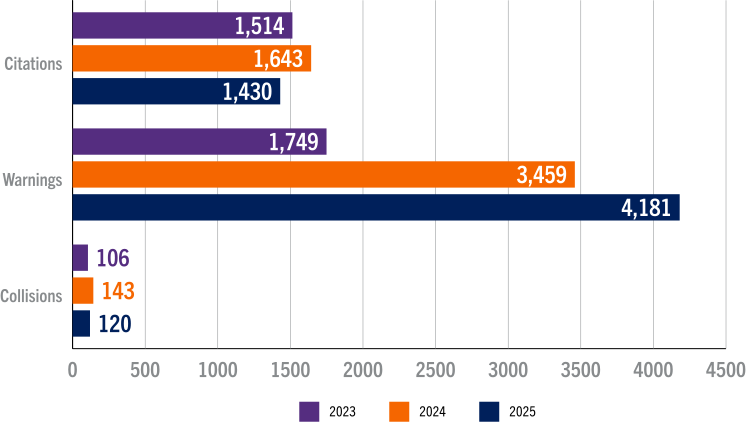
The Number of Citations, Warnings, and Collisions graph provides enforcement outcomes based on targeted efforts resulting from the data collection and analysis conducted throughout 2025 in addition to proactive and self-initiated law enforcement activity in response to officer observed violations.
Alcohol-Related Incidents and Enforcement
In 2025, CUPD conducted three Alcohol Enforcement Team operations, two of which involved mutual aid partners throughout the City of Clemson. A directed patrol of on-campus residential living areas supporting underage drinking prevention was conducted in the fall of 2025. Officers on patrol have built meaningful relationships with residential life staff by conducting walkthroughs, attending community events, and presenting on the importance of alcohol safety.
In 2025, CUPD delivered six (6) sessions of the IMPACTed program, an educational program on the dangers of risky alcohol utilization and drug abuse developed in partnership with campus partners and Clemson University Municipal Court.
The Alcohol-Related Incidents graph provides a visual representation of Public Disorderly Conduct arrests (PDC), Alcohol-Related Medical Calls and Alcohol-Related Medical Transports that occurred during 2025 in comparison with the previous two years.
- Public Disorderly Conduct charges result after an officer comes in contact with an individual who is grossly intoxicated in a public place.
- Alcohol-Related Medical Calls are calls that require an EMS response for evaluation but do not result in transport to a medical facility.
- Alcohol-Related Medical Transports are calls that require transport to a local hospital for further evaluation after EMS personnel have screened an intoxicated person.
Alcohol-Related Incidents (2023-25)
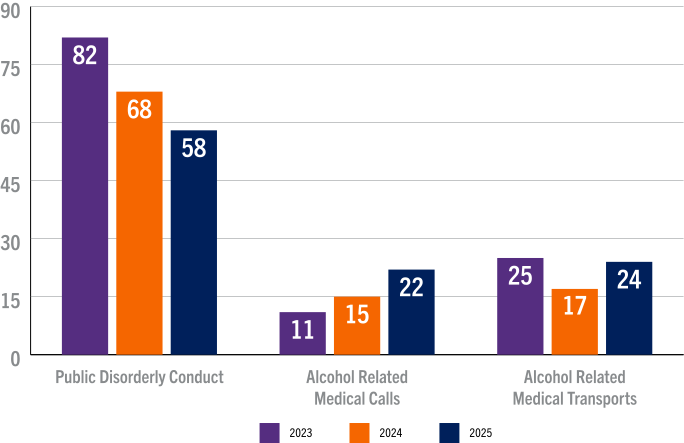
The Alcohol-Related Incidents graph highlights that over the three-year period from 2023 to 2025, the department observed notable fluctuations in public disorderly conduct and alcohol related medical calls and transports.
Public Disorderly Conduct cases maintained a steady decrease from 82 in 2023 to 58 in 2025. Alcohol-Related Medical Calls have shown a moderate increase yearly over the past three years. The number of medical transports due to alcohol in 2025 saw a similar number to 2023 with a moderate increase over the brief decline observed in 2024.
While the increase in calls for service in these categories may well be attributed to the expanded work of bystander intervention training across the campus, resulting in a greater number of requests for assistance, the trend has demonstrated a need for targeted attention as part of CUPD’s 2026 annual goals.
The Alcohol Enforcement Actions graph depicts the number of enforcement actions for incidents related to Driving Under the Influence (DUI) and Liquor Law Violations for 2023-2025. Liquor Law Violations include Possession of Beer or Liquor Under Age 21 and Open Container charges made by officers.
Alcohol Enforcement Actions (2023-25)
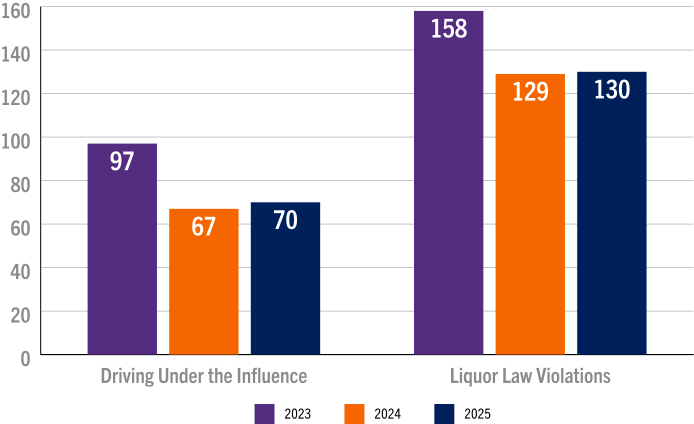
Driving Under the Influence offenses and Liquor Law Violations increased by less than 1% during the 2025 calendar year. These totals represent direct enforcement actions taken, but more pointedly indicate the sustained impact of regular directed patrol and targeted enforcement activities conducted throughout the year.
Enforcement observations in 2025 show a notable prevalence of the use of false identification associated with each category of alcohol-related offense. While not in and of itself a category of alcohol offense, the possession and corresponding utilization of “fake IDs” is a regular companion of underage alcohol utilization, a practice which has been observed to increase significantly over the past few years.
In 2023, CUPD made 112 charges for possession of fake ID, which increased slightly in 2024, with 115 charges. In 2025, there were 97 charges, a 15.7% decrease, however, there were an additional 60 incidents in which a fake ID was discovered and referred to the Office of Community and Ethical Standards rather than making a charge.
The possession of false identification, while utilized extensively to acquire alcohol underage or obtain access to alcohol establishments with age restrictions for the purpose of consumption, has been regularly tied to non-alcohol-related offenses where officers confiscate the false ID as a result of some other contact. During field interviews with these individuals, officers are regularly reporting back that many students obtain false identification cards as much for gaining access to age-restricted establishments due to socialization norms.
Crime Reporting
The categories presented in the Crime Summary by Month graph represent Part 1 Crimes as defined under the FBI’s Uniform Crime Reporting (UCR) standards and include Murder, Kidnapping, Rape, Fondling, Robbery, Aggravated Assault (Agg Assault), Burglary, Larceny, Motor Vehicle Theft (MVT), and Arson.
The FBI’s Uniform Crime Reporting (UCR) Program is a nationwide, cooperative statistical effort of city, university and college, county, state, tribal and federal law enforcement agencies voluntarily reporting data on crimes reported in their jurisdictions. The graph provides Part I Offenses reported by CUPD and represents the most accurate data available at the time of this report.
Crime Summary By Month (2025)
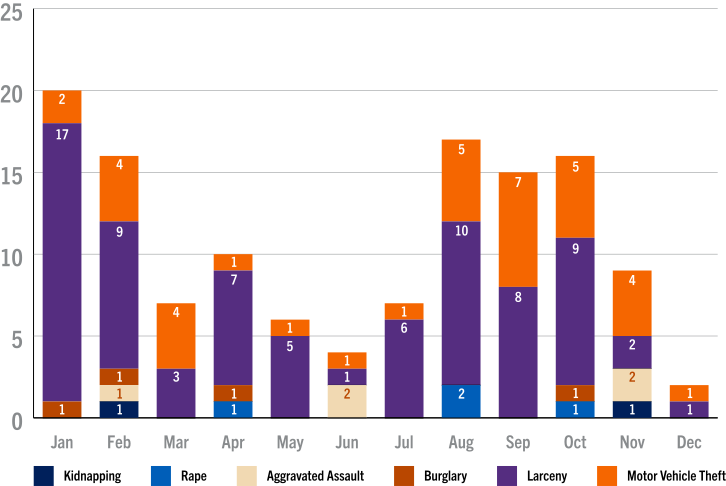
In 2025, statistics for most categories of larcenies decreased by 33% from 2024 with 78 larcenies (116 in 2024) and remained on par with 36 motor vehicle thefts (34 in 2024). A common theme in most of the larceny cases involved items being left unsecured in offices, academic facilities, or vehicles. When thefts occurred from motor vehicles, the vast majority were unlocked with items left in plain view.
In the cases of motor vehicle theft, most thefts involved mopeds, scooters and golf carts which by definition are categorized the same as traditional motor vehicles under Uniform Crime Reporting standards. Again, these thefts occurred when owners left vehicles unsecure and in many cases with the key in ignitions.
CUPD has implemented active campaigns to educate students, staff, and faculty about the importance of securing property to prevent thefts and other losses. In addition to crime prevention bulletins, tips and education, CUPD has also invested in technology to address these issues. The department currently utilizes an anti-theft tracking system, as well as a robust electronic surveillance system as proactive measures to deter crime and identify offenders.
Five sexual assault cases and five aggravated assaults were reported across campus in 2025. One of the sexual assaults was reported anonymously with no details provided to law enforcement. Two of the reported cases occurred off campus and were referred to the appropriate jurisdiction.
Of the aggravated assault cases, none involved weapons such as firearms or blunt objects other than personal weapons (hands and feet). One case resulted in an arrest. Two cases involved inappropriate touching. None of the cases resulted in severe physical injury to the victim.
