Professional Standards
The Professional Standards Office plays a vital role in ensuring that the Clemson University Police Department operates within the boundaries of public trust and established guidelines. Upholding the highest standards of integrity, the office's administrative investigative processes are integral to building and maintaining the confidence of the community we serve.
Accreditation
CUPD was awarded its initial accreditation on March 26, 2021, by the Commission on Accredited Law Enforcement Agencies (CALEA). The purpose of CALEA accreditation is to establish a foundation within public safety agencies that focuses on achieving the best results in the delivery of services. CALEA accreditation combines consistent internal and external review with third-party validation of an agency’s policies and procedures and is considered the “Gold Standard” in public safety.
The Professional Standards Office oversees the department’s CALEA accreditation process and ensures that the agency remains in compliance with established standards and best practices on an ongoing basis. Continuous assessment takes place through annual reviews with a full on-site review conducted by the Commission every four years.
CUPD went before the Commission in March 2025 as part of the agency’s four-year cycle review and was awarded reaccreditation, marking the agency’s second award.

Professional Standards Investigations
Key responsibilities of the Professional Standards Office include the investigation, management, and review of complaints and allegations involving departmental personnel. This ensures accountability and reinforces the department’s commitment to ethical conduct.
The department’s reputation and public perception relies heavily on the personal integrity and discipline of every employee. A professional and transparent response to complaints and allegations of misconduct is essential to preserving the department's image and fostering community trust.
Additionally, the Professional Standards Office tracks critical reporting functions for all "Response to Resistance/Aggression" reports submitted by officers, review and reporting of all employee-involved vehicle collisions, documentation and analysis of all vehicle pursuit incidents, and the Personnel Early Intervention System. These responsibilities ensure accountability and consistency in our operations, reinforcing the department's commitment to safety, integrity, and professionalism.
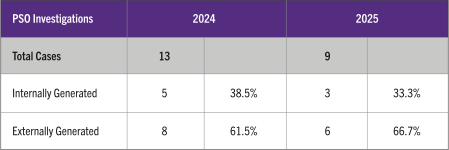
During the 2025 calendar year, the Professional Standards Office documented, managed or handled 9 investigations, a 30.7% decrease from 2024.
Depicted in the following table are the number of investigations in 2025 compared to 2024, including the percentages of cases initiated internally (by members of the police department) versus externally (by individuals outside the department).
2025 Allegations
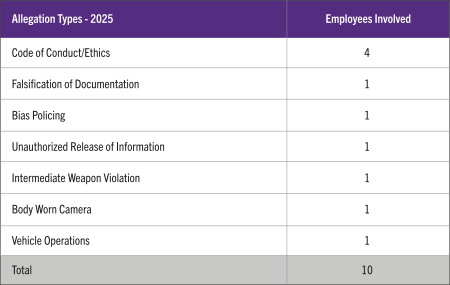
There were ten (10) allegations linked to nine (9) cases in 2025. A review of the types of allegations investigated in 2025 are noted in the table below.
2025 Disposition of Allegations
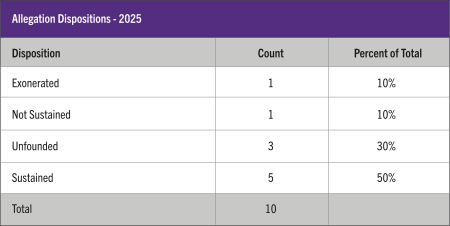
A review of the dispositions for the 10 (ten) employees across nine (9) cases in 2025 is depicted in the following table.
Fair and Impartial Policing
Fair and impartial policing is the cornerstone of public trust and confidence in law enforcement and is foundational to fostering relationships between law enforcement and the communities they serve. When police officers are perceived as fair and unbiased, the public is more likely to trust, respect, and cooperate with officers. Positive interactions and impartial treatment help strengthen relationships between law enforcement and the public, creating a safer and more collaborative environment where community members feel secure working with the police. Furthermore, communities that trust law enforcement are more likely to report crimes, share information, and assist in investigations, which is crucial for preventing and solving crimes effectively.
During 2025, there was one underlying complaint of potential misconduct related to fair and impartial policing. After reviewing body camera footage and other investigative tactics related to potential acts of misconduct in fair and impartial policing, the investigation found the allegations unfounded.
CUPD conducts annual roll call and in-service training on Fair and Impartial Policing issues, following established guidelines. All documentation for completed training is stored in Professional Development and Training (PD&T). It is recommended that this training module be maintained and supplemented with additional resources, including those from the Gantt Multi-Cultural Center, to further enhance education and knowledge.
An analysis of investigations by the Professional Standards Office revealed no significant patterns or trends suggesting a need for policy changes or additional training, indicating that CUPD’s Professional Development and Training Division continues to deliver high-quality in-service training across various areas.
Response to Resistance
2025 saw a marked decline in response to resistance incidents in comparison to the preceding year's sample.
Response to Resistance Incidents
-
122024
-
22025
-
83%Decrease in Incidents
These numbers highlight a continuing effort by CUPD to provide officers with training, tools, and personnel to effectively respond to incidents where resistance is a factor in the safest manner possible. While available data to analyze remained low, it can still be inferred that alcohol use remained a primary and/or secondary factor in citizen encounters where a response to resistance occurred between January 2022 through December 2025.
During these encounters, CUPD officers consistently demonstrated best practices and applied lessons learned when taking enforcement actions. The department’s ongoing commitment to Professional Development and Training, including internal training initiatives and external programs like Crisis Intervention Training, ICAT, and defensive tactics, has been instrumental in maintaining high standards.
Each reported incident, regardless of the year, underwent thorough review by multiple levels of oversight. This process includes a full command review beginning with the involved officer’s supervisor and concluding with the Chief of Police. Following these comprehensive evaluations, it was concluded that all incidents involving officer-citizen encounters were proportionate and objectively reasonable.
A comparative analysis of data from 2022 to 2025 was conducted to identify trends, enhance officer effectiveness and efficiency, improve training programs, increase employee safety, and provide actionable insights for agency management. These efforts aim to address resistance to police responses and improve interactions with the community served by the Clemson University Police Department.
CUPD recognizes that response to resistance interactions present opportunities for diverse responses from both the community and the department. While it is not always possible to prevent all instances of resistance or aggression, CUPD is committed to proactive prevention through various approaches with a purposeful emphasis on de-escalation training.
CUPD mandates that all personnel undergo Crisis Intervention Training (CIT), providing officers with skills to respond effectively to potential mental health crises. CUPD continues to engage with University research partners, the National Alliance on Mental Illness, and the South Carolina Department of Behavioral Health and Developmental Disabilities Office of Mental Health in taking a leading approach to law enforcement training and response to mental health crises in South Carolina.
As a result of ongoing training efforts, officers are better equipped to utilize de-escalation techniques over physical force. However, there are instances in which all means of de-escalation were exhausted, and physical force in response to continued resistance and non-compliance was required.
Vehicle Pursuits
An annual review and analysis of vehicle pursuit incidents from January 2025 through December 2025 was conducted in accordance with General Order IV-21 (Vehicle Pursuits). The 2025 Vehicle Pursuit Analysis was developed using data from reports submitted by officers of the Clemson University Police Department. Each category of data was independently reviewed and analyzed to identify potential patterns or significant trends. For a broader perspective, data from 2022 through 2025 were collected and compared.
Vehicle Pursuits (2022-2025)
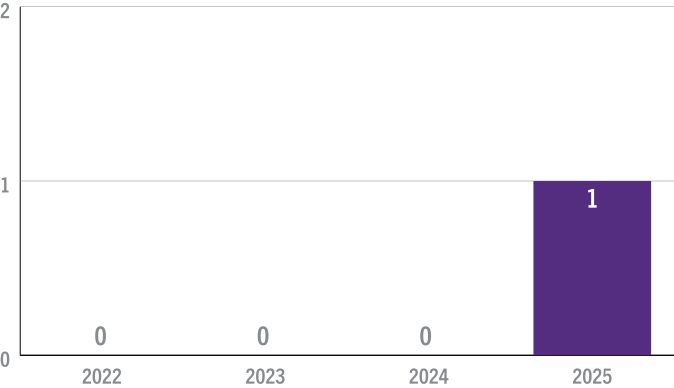
No vehicle pursuits were documented in 2022, 2023, or 2024 for analysis. In 2025, one vehicle pursuit was initiated. The incident began with an officer conducting stationary radar detecting a speeding violation. An attempted traffic stop was conducted; however, the vehicle increased speed and failed to stop after the officer activated emergency lights and sirens per policy. Due to the vehicle failing to stop and increasing speed, the officer terminated the pursuit due to the primary violation type in accordance with department policies and notified the surrounding counties.
CUPD General Order IV-21 Vehicle Pursuit provides a comprehensive decision-making framework for assessing the reasonableness and relative safety of vehicle pursuits. Policy clearly defines the levels of responsibility of both the officer(s) involved and the supervisor in determinations on continuing or terminating a pursuit.
While initial traffic stop attempts may be made for any valid, articulable reasonable suspicion or probable cause of a traffic offense or other crime, pursuits are only authorized when an officer has reasonable grounds to believe the suspect has committed or is attempting to commit the crimes of murder, manslaughter, rape or other felonious sex offense, kidnapping, robbery and aggravated assault.
Additionally, a pursuit may be authorized when an officer has reasonable grounds to believe a suspect has committed or is attempting to commit a crime which involves the use of a firearm or explosive device, even if such crime is classified as a misdemeanor and/or the occupants are armed and dangerous. Pursuits of motorcycles is only permitted when the suspect is believed to have been involved in a Class A felony and deadly force would be justifiably authorized.
