- About
-
Academics
- Academics Overview
- Course Numberings
- Deadlines for Completing Your Program
-
Theses and Dissertations
- Theses and Dissertations Overview
- Formatting Requirements
- Templates, Links and Tools
- Plain Language Abstracts
- Plagiarism
- Defending Your Thesis or Dissertation
- Converting Your Manuscript
- Requesting an Embargo
- Submitting
- Revising
- Finishing the ETD Process
- Bound Copies
- Survey of Earned Doctorates
- Thesis and Dissertation FAQs
- Policies and Procedures
- Forms and Requests
- Plan of Study
- Graduate School Interdisciplinary Program
- Graduation Ceremonies
- Admissions
- Professional Development
- Student Services and Groups
Graduate Student Mentoring Training
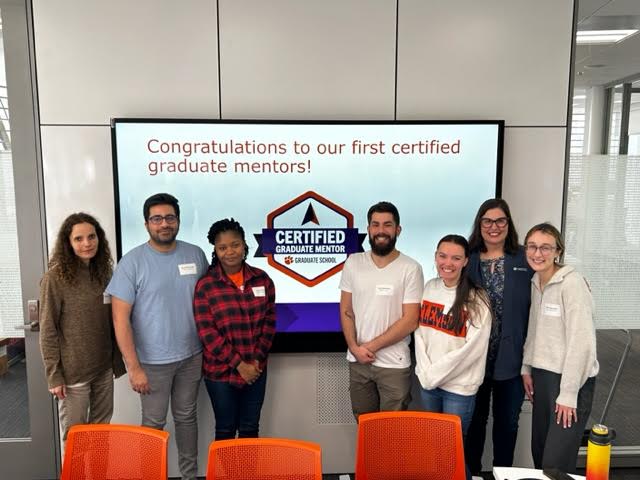
Graduate student mentoring modules are available for Master's and PhD students through Grad 360°.
For more information, email gradCTM@clemson.edu.
Modules
See below for details and learning objectives for offered modules.
-
Aligning Expectations
A clearly communicated and openly shared understanding of expectations is critical for a healthy and productive graduate mentee and faculty mentor relationship. Yet, mentees often face challenges in expressing their needs, establishing their own expectations, and asking for clarification--especially early on in their training. In this module, graduate students will explore strategies to gain confidence in communicating with mentors, practice articulating their own goals and expectations, and learn how to clarify their mentor's expectations. Participants will also be introduced to practical tools, such as mentoring agreements and Individual Development Plans (IDPs) to support ongoing, bi-directional conversations that adapt as needs and circumstances evolve.
As a result of participating in this event, attendees will be able to:
- Define mentoring relationships and your role as a mentor/mentee.
- Clearly communicate expectations for the mentoring relationship.
- Align mentee and mentor expectations.
- Clarify expectation of mentor(s).
-
Maintaining Effective Communication
Effective communication skills solidify the foundation of a strong graduate mentee and faculty mentor relationship. However, it may be challenging for graduate students and faculty advisors to navigate differences in communication styles, preferences, and expectations. Graduate mentees may also face uncertainty about how and when to raise concerns or share constructive feedback with their advisors. In this module, graduate students will reflect on their own communication strengths and identify areas for growth, practice strategies for expressing ideas and concerns clearly, and learn techniques for adapting to their mentor's communication style. Participants will work together to explore ways of initiating constructive conversations and maintaining open dialogue that fosters trust and mutual understanding throughout their graduate experience.
As a result of participating in this event, attendees will be able to:
- Communicate effectively across diverse dimensions including varied backgrounds, disciplines, ethnicities, positions of power, etc.
- Accept and use constructive feedback.
- Identify different communication styles/approaches.
- Use multiple strategies for improving communication (in person, at a distance, across multiple mentors, and within proper personal boundaries).
-
Assessing Understanding
A definitive understanding of research concepts, project goals, and disciplinary contexts are essential to graduate student success, yet it can be difficult to admit when something remains unclear. Many graduate mentees worry about revealing confusion to their faculty advisors, or fear that asking questions will reflect poorly on them. In this module, graduate students will learn strategies to recognize when they need clarification from their faculty advisors, practice ways to ask targeted questions, and develop skills for checking their own understanding of their work. Participants will also explore approaches for initiating conversations that close expert-novice gaps and build confidence in navigating complex research discussions.
As a result of participating in this event, attendees will be able to:
- Assess mentee’s understanding of core concepts.
- Assess mentee’s ability to develop and conduct a project.
- Identify reasons for lack of understanding, including expert-novice differences.
- Use multiple strategies to enhance mentee understanding across diverse disciplinary perspectives.
-
Promoting Professional Development
Professional development is central to graduate training, but it may be challenging for students to identify their long-term goals, communicate them to their mentors, and create a realistic plan for achieving them. Without clear alignment, opportunities may be missed or expectations may drift apart. In this module, graduate students will reflect on their short- and long-term career aspirations, learn how to use tools and resources to set and track professional goals, and practice initiating productive goal-setting conversations with their mentors. Participants will also explore strategies for revisiting and revising their plans as their interests and opportunities evolve.
As a result of participating in this event, attendees will be able to:
- Identify the roles mentors play in the overall professional development of their mentees.
- Develop a strategy for guiding professional development.
- Engage in open dialogue on balancing the competing demands, needs, and interests of mentors and mentees.
-
Promoting Independence and Research Self-Efficacy
Developing independence and confidence as a researcher is a key milestone in graduate education, but it can be difficult to know exactly what “independence” looks like—or how to get there. Graduate students may feel unsure about when to seek guidance versus when to take the lead, especially as expectations shift over time. In this module, participants will reflect on what research independence means in their field, identify the skills and experiences they need to build it, and learn strategies for communicating with their mentors about taking on more responsibility. The module will also explore ways to strengthen research self-efficacy so students can navigate their work with greater confidence and autonomy.
As a result of participating in this event, attendees will be able to:
- Define independence in mentoring relationships.
- Identify benefits and challenges of fostering independence.
- Define self-efficacy and its four sources.
- Articulate your role in building your own self-efficacy.
- Devise strategies to support others’ research self-efficacy.
-
How to Communicate Effectively with Your Advisor
In this module, graduate students will consider strategies to more effectively engage and communicate with their advisor(s). Issues such as handling negative feedback, imposter syndrome, advisor availability, work load, oversharing, navigating team meetings and building positive relationships will be discussed. Participants will engage with other graduate students to learn successful techniques that will provide participants with actionable strategies for effective communication with their advisor.
As a result of participating in this event, attendees will be able to:
- Understand the role of effective communication strategies.
- Reflect on strategies for navigating feedback and building positive relationships.
- Develop skills for articulating academic and professional goals and addressing concerns.
-
Mentoring and Advising the Online Student
For graduate students pursuing their degrees online, building strong mentoring relationships can be more challenging without regular in-person interactions. Remote learners often need to be intentional about establishing connections, communicating effectively, and accessing resources from a distance. In this module, online graduate students will identify their unique needs and strengths as remote learners, explore inclusive and effective communication strategies, and practice approaches for initiating and sustaining productive relationships with faculty mentors. Participants will also learn how to use practical tools and templates to support progress, stay engaged, and thrive in a virtual academic environment.
As a result of participating in this event, attendees will be able to:
- Recognize the unique advising and mentoring needs of being an online graduate student, including challenges related to isolation, time zones, engagement, and institutional navigation.
- Consider inclusive, flexible, and intentional communication strategies to foster connection, trust, and student growth in virtual mentoring relationships.
- Develop strategies to develop goals moving forward.
-
Mentoring for Research to Practice Translation
Bridging the gap between research and real-world application is a valuable skill for graduate students. Navigating issues like publication authorship, prototyping, patenting, and intellectual property often requires both technical expertise and strategic mentorship that may feel complex and unfamiliar when one is new to this process. In this module, graduate students will gain insight into the pathways for translating research into practice, learn how to engage mentors in conversations about these processes, and explore strategies for building collaborations that support innovation. Participants will also connect with peers to share experiences and develop practical approaches for managing the professional and ethical considerations involved in bringing research beyond the lab.
As a result of participating in this event, attendees will be able to:
- Understand how to guide researchers in understanding the impact of publication and prototyping on research translation.
- Examine best practices and lessons learned for research to practice mentoring.
- Consider how to integrate undergraduates in the process.
-
Mentoring for Responsible Conduct of Research (RCR/RECR)
Conducting ethical, high-quality research is essential for building trust in science and advancing knowledge. Graduate students play a key role in upholding research integrity, yet navigating the complex expectations and requirements can be challenging. In this module, participants will be introduced to the core principles of responsible and ethical conduct of research (RCR/RECR) and explore topics such as data integrity, authorship practices, conflicts of interest, and the role of mentorship in maintaining ethical standards. Through discussion and case studies, graduate students will gain practical strategies for applying these principles in their work and learn about federal training requirements that may apply to their research.
As a result of participating in this event, attendees will be able to:
- Identify core principles of responsible and ethical conduct of research in compliance with NSF and NIH RCR/RECR training requirements.
- Analyze ethical dilemmas in research to recognize potential challenges and consider appropriate actions.
- Develop strategies to uphold ethical research practices that meet both professional standards and grant compliance requirements.
-
Mentoring for Research Skills Development
Building strong research skills is a continual process throughout your graduate education and beyond and knowing where to focus your efforts accelerates your growth. Graduate students benefit from identifying their current strengths, recognizing skill gaps, and creating a clear plan for development with their mentors. In this module, participants will assess their current research capabilities, prioritize areas for improvement, and apply a structured Researcher Development Framework (RDF) to guide their progress. Students will leave with a personalized plan to guide and strengthen their research skills as they pursue their future graduate, professional, and career goals.
As a result of participating in this event, attendees will be able to:
- Assess personal research skills using the 63 elements of the "Researcher Development Framework" to identify strengths and areas for improvement.
- Analyze a case study to prioritize key research skills and explore strategies for skill development in a mentoring context.
- Develop effective communication strategies for discussing research skill development needs with mentors to foster supportive mentoring relationships.
-
Capstone: Building your Mentoring Philosophy
Developing a personal mentoring philosophy can help graduate students clarify how they want to engage with their mentees and why effective mentoring practices matter. Reflecting on past experiences, values, and strengths can guide graduate students in shaping their approach to mentoring others. In this module, participants will discover their own mentoring values based on what they have learned from their mentoring relationships and training and begin crafting a mentoring philosophy that aligns with their style and aspirations. By the end of this module, students will outline a framework for how they want to mentor peers, undergraduate students, or future colleagues with purpose and confidence.
As a result of participating in this event, attendees will be able to:
- Clarify your mentoring style and values.
- Identify what’s working—and what you’d like to improve.
- Create a plan for how you want to support others moving forward.
-
Entrepreneurial Minded Mentorship
In collaboration with NSF STRIDE:
An entrepreneurial mindset (EM) can help graduate students approach their education, professional development, mentoring relationships, and future careers with greater curiosity and purpose. Entrepreneurial minded learners ask meaningful questions, make connections across ideas, people, and disciplines, and consider how their knowledge and experiences can create value for others. In this module, graduate students will explore KEEN’s 3Cs (Curiosity, Connections, and Creating Value) and apply them to their own graduate experiences and career development. Participants will practice recognizing opportunities, exploring stakeholder needs, making connections across people, disciplines, ideas, and resources, and considering how their experiences can create value. Students will identify ways to use an entrepreneurial mindset to take action on opportunities, engage more intentionally with mentors and other stakeholders, and navigate diverse academic, industry, entrepreneurial, research, and other professional pathways.
As a result of participating in this event, attendees will be able to:
- Apply Curiosity, Connections, and Creating Value to identify opportunities within their graduate education and professional development.
- Use entrepreneurial mindset strategies to explore stakeholder needs and make connections across people, disciplines, ideas, and resources.
- Articulate the value and potential impact of their graduate experiences and identify actions that can move ideas and opportunities toward meaningful outcomes.
-
Fostering Work-Life Integration
Balancing graduate school responsibilities with personal well-being is essential for long-term success, yet many students struggle with stress, anxiety, and burnout. These challenges can affect productivity, relationships, and overall satisfaction with graduate training. In this module, graduate students will explore strategies for setting healthy boundaries, managing time and priorities, and maintaining well-being while pursuing their academic goals. Participants will also learn practical approaches for fostering a sustainable work-life integration, building resilience, and creating habits that support both professional growth and personal health. Resources to support these strategies and approaches will be provided.
As a result of participating in this event, attendees will be able to:
- Recognize the importance of proactive well-being for mentors and mentees.
- Understand both the protective as well as the risk factors for graduate student mentee mental health.
- Identify concrete strategies for support if you are experiencing mental health challenges and are already seeking counseling or other resources.
Badges
Graduate students can earn a digital badge for participation after participating in 4 mentoring modules. Two workshops are required to earn a graduate student digital badge (Aligning Expectations and Maintaining Effective Communication), and you may choose any other two modules above to receive the certified mentor badge.