- Careers
- Employees
- Supervisors and HR/Payroll Liaisons
- Benefits and Wellness
- Logins and Resources
Tackling Burnout and Fatigue
Resources and Tools
The Office of Human Resources recognizes that employees are faced with demands both professionally and personally that may lead to them experiencing job burnout. To support our employees, our office has resources and tools available to employees to evaluate and reduce job burnout.

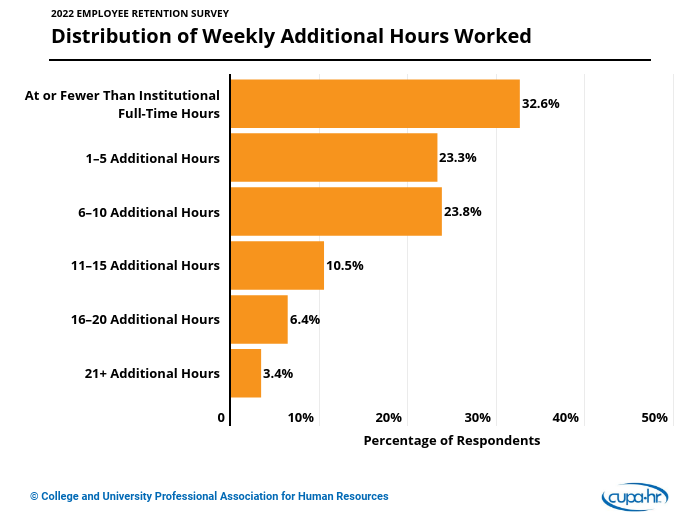
2022 Employee Retention Survey
Distribution of Weekly Additional Hours Worked
At or Fewer Than Institutional Full-Time Hours: 32.6%
1-5 Additional Hours: 23.3%
6-10 Additional Hours: 23.8%
11-15 Additional Hours: 10.5%
16-20 Additional Hours: 6.4%
21+ Additional Hours: 3.4%
Beyond Full-Time: Many Higher Ed Employees Are Burning the Candle at Both Ends
Approximately two-thirds (67%) of full-time higher ed employees work more hours each week than what is considered full-time. Notably, 10% of employees work 16 hours or more of additional hours per week. Only 1% of employees typically work less than is expected of full-time workers at their institution.
© 2022 COLLEGE AND UNIVERSITY PROFESSIONAL ASSOCIATION FOR HUMAN RESOURCES
Source: The CUPA-HR Employee Retention Survey: Initial Results (PDF)
Employee Resources
Tackling the Problem of Burnout in a Workplace
When work demands increase, the life side of the work–life balance scale drops. Fortunately, you can take back control of your life and still give your best at work. Isn’t it time to find the right balance?
Overcoming Burnout in the (Nearly) Post- Pandemic Workplace
Do you feel like a salmon swimming upstream? Do you relate to “I Love Lucy” and the conveyor belt of chocolates? Has “I just can’t” become your motto? Clinical psychologist, anxiety specialist, and author of How to Be Yourself: Quiet Your Inner Critic and Rise Above Social Anxiety Dr. Ellen Hendriksen has you covered.
Tips to Better Cope with Stress
When you're constantly adding items to your never-ending to-do list, feeling overwhelmed at work and at home, and finding your health and relationships negatively impacted, you are likely experiencing stress.
Rediscovering Your Joy at Work: A Discussion for Higher Ed Leaders
If you are looking for ideas and inspiration to help you and/or your team rediscover a sense of joy and meaning in their everyday work and want to share existing strategies that you or your team are employing to do the same, this discussion is for you.
Engaging in Empathy: Balance the Emotional Demands
You may be particularly interested in this training if you’re struggling to practice empathy consistently and regularly because of exhaustion or burnout, or you feel you may be overusing empathy and need to find balance.
Therapy Assistance Online (TAO)
TAO includes over 150 brief, effective, educational sessions covering over 50 common topics and skills related to mental health, wellness and substance use issues. TAO Includes interactive sessions, mindfulness exercises and practice tools all aimed at helping you achieve your goals.
Supervisor Resources
Recognizing Symptoms of Stress in Employees
You’ll come to recognize symptoms of stress and burnout in your people and discover methods you can use to help them balance the demands of work and private life.
Stabilizing Your Employees’ Balancing Acts
In this course, you’ll discover the impact of work on three major areas of work life and how facets of wellness programs can help support your employees in those areas.
Responding to Burnout and Attrition in Higher Education
This session will be valuable for both unit-level leaders (at all levels, from Manager to VP), as well as those who support leaders across campus, including those in HR, Faculty Affairs, DEI and others.
Managing Faculty Stress and Burnout: A Conversation for Faculty Affairs and Academic Leaders
This webcast has been designed for faculty affairs leaders, deans, associate/assistant deans, department chairs, and other academic leaders involved in faculty support.
In this session, the presenter describes the signals that leaders can watch for and introduce strategies to help them prevent burnout from impacting the workforce.
Re-Energize a Team that Shows Signs of Burnout
In this article, you will find “the power to motivate your team lies in placing opportunities before them to learn and grow. Making them responsible for due diligence and research creates an environment where workers can motivate themselves.”
