
CMERL
Cardiovascular Modeling & Experimentation Research Laboratory
Research themes: 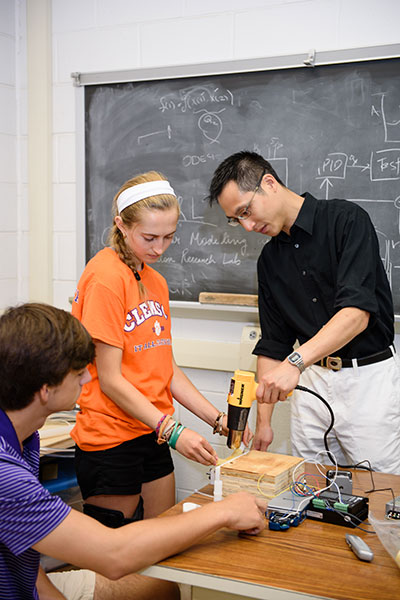 The Cardiovascular Modeling & Experimentation Research Laboratory (CMERL) at Clemson University focuses on translational research, which develops and integrates experimental and computational tools to help advance cardiovascular medical devices, diagnostics, and clinical procedures. Our interdisciplinary research involves close collaborations with clinicians and broad areas of Electrical, Biomedical, and Mechanical Engineering. We collaborate closely with the Medical University of South Carolina and clinicians worldwide—from the North American West Coast to Europe and beyond—to ensure our research remains aligned with current clinical needs. The ultimate goal of our research is to combine the power of engineering and medicine, improve the lives of patients with cardiovascular diseases, and have lots of fun doing this.
Building on this mission, CMERL develops and applies multi-scale cardiovascular modeling frameworks, ranging from lumped-parameter systemic physiology models to patient-specific three-dimensional computational fluid dynamics. These tools allow us to investigate disease mechanisms, optimize surgical and device strategies, and perform “virtual surgeries” to predict clinical outcomes before intervention. Our lab also develops physiologically realistic in-vitro experimental platforms that replicate patient anatomy and hemodynamics, enabling safe, controlled testing of cardiovascular devices and procedures. These benchtop systems support both device development and emerging paradigms in personalized medicine, where patient-specific experiments can inform clinical decision-making.
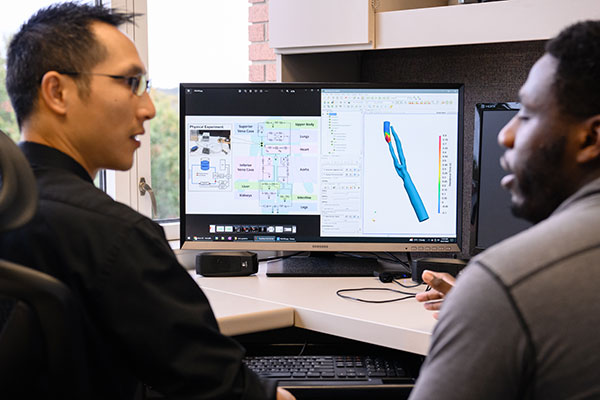 A distinctive strength of CMERL is its pioneering hybrid experimental–computational modeling, exemplified by the Physiology Simulation COuPled Experiment (PSCOPE). This hardware-in-the-loop framework couples benchtop in-vitro experiments with numerical physiology simulations, enabling simultaneous physical device testing and computational prediction of patient responses. PSCOPE has been applied to problems such as ventricular assist device implantation and cavopulmonary support in single-ventricle patients, demonstrating its potential to transform pre-clinical evaluation of cardiovascular technologies.
Our publications span topics including patient-specific hemodynamics, congenital heart disease, ventricular assist devices, carotid artery disease, tissue-engineered heart valves, and predictive modeling for surgical planning. Together, these efforts position CMERL at the intersection of engineering innovation and clinical translation, advancing tools that help clinicians make better decisions and ultimately improve patient outcomes.
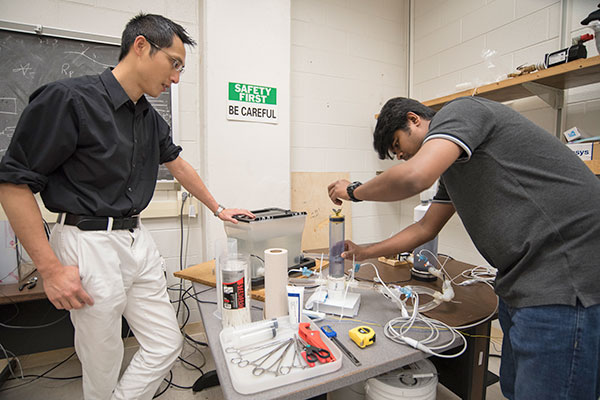 Lab Facility and Equipment The laboratory is equipped with a dedicated water supply and sink to support preparation for flow‑loop experiments, access to the Clemson University high‑performance computing cluster for resource‑intensive simulations, and specialized three‑phase power outlets for precision servo‑motor actuation. The facility is located adjacent to the Mechanical Engineering department’s prototyping and machining shop, enabling rapid fabrication and modification of experimental components. Available equipment includes ultrasonic flow meters and sensors, high‑precision catheter‑based pressure transducers, precision servo and stepper motors for flow control, and a range of data‑acquisition modules.
Please visit the Cardiovascular Modeling & Experimentation Research Laboratory website for additional information.

Ethan Kung
Lab Director
(864) 656-7291
ekung@clemson.edu
